
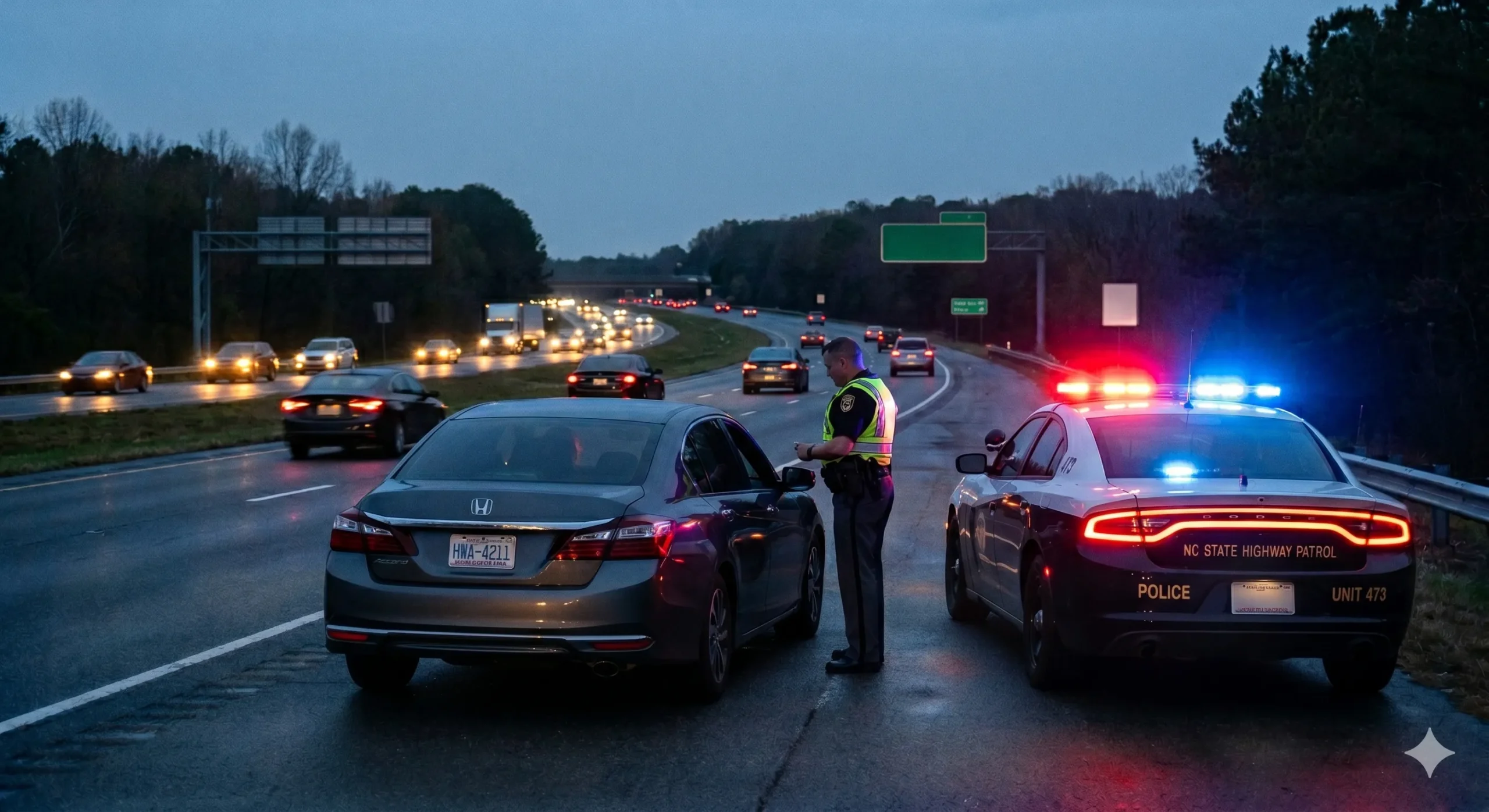
Here’s the scene. You’re driving down Battleground Avenue or sitting at a light on Elm Street. Blue lights flash behind you. You pull over. The officer walks up, does the usual — license, registration — and then says those six words that make your stomach drop:
“Mind if I take a look around?”
What do you do? What are you allowed to say? What happens if you say no? What happens if you say yes?
These are not hypothetical questions in Greensboro. According to the NC Department of Public Safety, North Carolina law enforcement conducted over 1.2 million traffic stops in 2022 alone — and Guilford County, home to both Greensboro and High Point, sees tens of thousands of those stops every year. A lot of those stops end with an officer asking exactly that question.
Most people don’t know their rights. And that gap — between what police can legally do and what people think they can do — is where cases are won and lost every single day in Guilford County court.
Attorney Micah Huggins has been fighting for clients’ rights in these situations for over a decade. This page is here to close that knowledge gap — in plain English, with real legal context, and real local numbers behind it.
★ Key Takeaways — Know These Before You Get Pulled Over
- The Fourth Amendment protects you from unreasonable searches and seizures — including your car — whether you’re in Greensboro, High Point, or anywhere else in North Carolina.
- Police generally need a warrant, your consent, or probable cause to search your vehicle. Saying “no” to a consent search is your constitutional right.
- You do NOT have to consent to a vehicle search in NC. Politely saying “I do not consent to a search” is legal, protected, and smart.
- NC was the first state in the country to require police to collect traffic stop data — and the numbers reveal how often searches happen without solid legal basis.
- In North Carolina, consent searches once made up 50% of all vehicle searches. That number has dropped — but officers still ask regularly, and many drivers say yes without knowing they can refuse.
- The 2023 NC Supreme Court decision inState v. Juliusreinforced that illegally obtained evidence can be challenged and suppressed — even after a conviction.
- An illegal search doesn’t just matter morally — it can get the charges against you thrown out entirely.
- Attorney Micah Huggins has over a decade of experience challenging unlawful searches in Guilford County courts. Know your rights — and call us if they were violated.
How Often Do Police Search Cars in Greensboro and High Point — and What Does the Data Show?
Let’s start with some numbers most people never see.
North Carolina made history in 1999 when it became the first state in the nation to require the collection of traffic stop data — meaning every time a cop pulls someone over and searches their car, it gets logged. That database covers every police department in the state, including Greensboro PD and High Point PD. University of North Carolina researchers have analyzed those numbers extensively, and what they found is striking.
1.2M+ Traffic stops in NC in 2022 aloneNC Dept. of Public Safety, 2022
63% of probable cause searches now dominate all NC vehicle searchesNC Newsline / SBI Data
22% of searches are still consent searches — down from 50% a decade agoNC Newsline / SBI Data
115% more likely Black drivers were searched compared to white drivers statewideUNC/USC Research, statewide NC data
1,802 motor vehicle thefts in Greensboro in 2024 — up from 1,506 in 2023FBI / CPI Security, 2024
88% drop in Greensboro equipment-violation stops after GPD policy changeGreensboro City Council Reports
That last number says a lot. During a five-year period, Greensboro police stopped nearly 25,000 drivers on suspected equipment violations — 63.8% of them Black. When the department changed its policies following that New York Times front-page story, stops for equipment violations dropped 88% almost overnight. That tells you something real about why a lot of those stops were happening in the first place.
The point here isn’t to demonize police — most officers are doing their jobs the right way. The point is this: vehicle searches happen constantly in Greensboro and High Point, they’re not always legally clean, and whether evidence from a search is admissible in court often comes down to what happened in those first few minutes on the side of the road — and whether you had a lawyer who knew how to challenge it afterward.
Local Context: According to UNC Professor Frank Baumgartner’s traffic stop database, Greensboro and High Point each have their own detailed traffic stop profiles tracked separately from 2002 through 2020. The data show persistent search rate disparities and shifting patterns in how officers justify searches. This is the kind of context an experienced local defense attorney brings to your case.
What Does the Fourth Amendment Actually Say About Searching Your Car in North Carolina?
Here it is, plain and simple: the Fourth Amendment to the U.S. Constitution says the government can’t do “unreasonable searches and seizures.” That protection applies everywhere — your home, your phone, your body, and yes, your car.
Your vehicle has what courts call a “reduced expectation of privacy” compared to your home — meaning the bar for a warrantless search is lower than it would be if police wanted to walk through your front door. But it’s still a real, meaningful bar. And when police don’t clear it, any evidence they find can be challenged.
There are three main situations where police can legally search your car without a warrant in North Carolina. Understanding all three is how you protect yourself.
Situation 1: You Give Consent
This is the one that trips people up most. If you say yes — even casually, even with a shrug — you’ve just legally waived your Fourth Amendment protection. The search is valid. Whatever they find can be used against you in court.
Officers in North Carolina often phrase it in the most low-key way possible: “Mind if I just take a quick look?” That casual phrasing is intentional. It doesn’t sound like a big deal. But it is.
You have the absolute legal right to refuse a consent search in North Carolina. The correct response is calm, clear, and direct: “I do not consent to a search.” Not confrontational. Not argumentative. Just those six words. Officers are not required to tell you that you can refuse — so most won’t. But you can. And knowing that can change everything.
Important: even if you refuse, police may still conduct a search if they believe they have probable cause (more on that next). But your refusal on the record matters enormously later, in court, when your attorney is arguing about whether that search was legal.
Situation 2: Probable Cause
Probable cause means the officer has specific, articulable facts — not a hunch, not a feeling — that lead a reasonable person to believe your vehicle contains evidence of a crime. Classic examples include:
- The smell of marijuana coming from the vehicle
- Drugs or weapons visible in the car (plain view doctrine)
- Evidence consistent with recent criminal activity
- A credible tip from a reliable informant
Here’s where it gets important: probable cause has to be real. “You seemed nervous” isn’t probable cause. “You were in a high-crime area” isn’t probable cause. An officer’s gut instinct doesn’t meet the legal standard. And in North Carolina courts, a skilled defense attorney will challenge exactly what that officer’s probable cause actually was — and whether it actually existed.
The North Carolina Supreme Court reinforced this in the landmark 2023 case State v. Julius, 385 N.C. 331. The Court held that when the legal basis for a search falls apart — like when someone was searched but never actually arrested — the evidence from that search can be suppressed. The conviction in that case was reversed on appeal. That’s what a solid Fourth Amendment challenge can accomplish.
Situation 3: Search Incident to Lawful Arrest
If you’re placed under lawful arrest during a traffic stop, police can search your person and the area immediately around you — sometimes including the passenger compartment of the vehicle. But even this has limits. The 2023 Julius decision made clear that no arrest = no valid search incident to arrest. You can’t bootstrap the legality of a search by making an arrest after the fact based on what the illegal search turned up.
There are also two additional exceptions worth knowing:
Inventory Searches: When your car is impounded after an arrest, police can conduct an inventory search of the vehicle. This is treated differently from a standard probable cause search — it’s supposed to be administrative, not investigative. But defense attorneys examine these carefully to make sure they were handled properly.
Exigent Circumstances: If there’s a genuine emergency — like an officer believes someone in the car is in immediate danger — that can justify a warrantless search. Courts scrutinize these claims closely.
Can Police Search Your Car? A Plain-English NC Reference Guide
Here’s a quick-reference breakdown of common traffic stop scenarios and whether police have legal authority to search your car:
| The Situation | Can They Search? | What You Should Know |
|---|---|---|
| You say “yes” when asked | Yes — you consented | Consent waives your 4th Amendment protection. You can withdraw consent verbally at any time before the search concludes. |
| You clearly say “I do not consent” | Not on that basis | They need a separate legal basis (probable cause, arrest, etc.). Your refusal is protected and documented. |
| Officer claims to smell marijuana | Yes — probable cause | In NC, the smell of marijuana is still considered probable cause. Your attorney can challenge whether the officer actually smelled it. |
| Officer sees contraband in plain view | Yes — plain view doctrine | If something illegal is visible in the car, police can seize it and it often justifies a broader search. |
| You’re in a “high crime area” | Not by itself | Location alone is not probable cause. Courts have consistently rejected this as a standalone justification. |
| You appear nervous or fidgety | Not by itself | Nervousness alone does not constitute probable cause. Police can note it, but it doesn’t authorize a search. |
| You’ve been placed under arrest | Often yes — with limits | Search incident to arrest allows search of your person and immediate area. But State v. Julius (2023) set important limits. |
| Your car is being towed/impounded | Inventory search — maybe | Inventory searches are permitted for administrative purposes, but must follow standard procedures. Scope matters. |
| Officer has a search warrant | Yes — within warrant scope | Warrants must be specific. Your attorney can challenge whether it was properly obtained and whether the search stayed within its scope. |
| A drug dog “alerts” during a stop | Generally yes — but challengeable | A drug dog alert is treated as probable cause in NC. Your attorney can challenge the dog’s training, reliability, and the timing of the alert. |
What Should You Actually Do If a Greensboro or High Point Officer Asks to Search Your Car?
This is where knowing your rights meets knowing what to do with them. Here’s the step-by-step that a defense attorney would give you:
- Stay calm — completely calmYour demeanor matters. Don’t argue, don’t raise your voice, don’t make sudden movements. Staying calm keeps the situation safe and prevents things from escalating in ways that could be used against you later.
- Provide the required documentsDriver’s license, registration, and proof of insurance — you’re legally required to provide those. That’s it. You don’t have to answer questions beyond what’s necessary for the stop itself.
- When asked about a search, say this clearly“I do not consent to a search.” Say it calmly, once, and clearly. You don’t have to explain why. You don’t have to argue. Just state it plainly. In North Carolina, recording the encounter on your phone is generally legal as long as you don’t interfere with the officer’s duties.
- If they search anyway — do not physically resistIf the officer proceeds despite your refusal, do not physically resist. That makes things worse — potentially much worse. Your remedy is the courtroom, not the roadside. Remember everything you can: the officer’s name, badge number, the location, the time, what was said.
- Ask if you are free to goIf you’ve been stopped and the officer hasn’t indicated you’re being detained or arrested, you can ask: “Am I free to go?” If the answer is yes, calmly leave. If they’re detaining you, ask clearly why.
- Exercise your right to remain silentYou do not have to answer questions about where you’re going, where you came from, or what’s in your car. Politely invoking your right to remain silent and asking for an attorney is not suspicious — it is your constitutional right.
- Call a defense attorney as soon as possibleWhether the search turned up nothing or turned up something, call Huggins Law Firm immediately. If something was found, the window to challenge the legality of that search starts closing quickly — and early attorney involvement dramatically affects outcomes.
What Happens If the Search Was Illegal — Can the Evidence Be Thrown Out in North Carolina?
Yes. And this is one of the most important things to understand about Fourth Amendment law.
The legal doctrine is called the exclusionary rule. If police searched your car illegally — no valid consent, no real probable cause, improper procedure — then any evidence they found during that illegal search generally cannot be used against you in court. The legal term for this is “suppression.”
An experienced criminal defense attorney files what’s called a Motion to Suppress — essentially asking the judge to exclude the illegally obtained evidence. If that motion is granted? The prosecution’s case may collapse entirely. Charges get reduced. Cases get dismissed. That’s not a hypothetical — it happens regularly in Guilford County courts when the defense does its job right.
Real-World Application
How a Suppression Motion Can Change Everything
Police stop a vehicle on Wendover Avenue for a broken tail light. The officer asks to search. The driver says nothing — interpreted as neither consent nor refusal — and the officer proceeds. Drugs are found. An arrest is made. But here’s the problem: that driver’s silence was not consent. A defense attorney files a motion challenging the legal basis for the search. If the officer lacked true probable cause and didn’t have actual consent, the court may suppress the evidence. No evidence — no case. This is not a legal technicality. This is the Fourth Amendment doing exactly what it was designed to do.
The 2023 North Carolina Supreme Court decision in State v. Julius, 892 S.E.2d 854 is a powerful example of this at the highest level. The Court reversed a drug trafficking conviction because the vehicle search that produced the evidence was conducted without a valid legal basis. The search came first, the justification was invented after — and the NC Supreme Court said that wasn’t good enough.
It’s also worth knowing about what’s called the “fruit of the poisonous tree” doctrine. If an illegal search leads to more evidence — say, police find a key card in an illegal car search that then leads them to a storage unit with more drugs — all of it can potentially be suppressed, not just what was directly found in the car. The contamination of the illegal search spreads to everything it produced.
The bottom line: An illegal search is not just a moral problem — it’s a legal one that can unravel an entire case. But only if your attorney catches it, argues it, and knows how to present it to a Guilford County judge. That’s exactly what Micah Huggins does. Learn more about our criminal defense approach here.
Why Does Having a Local Greensboro Defense Attorney Matter So Much in These Cases?
Search and seizure law is federal law — it applies the same way in Greensboro as it does in New York City in principle. But the practice of litigating it? That’s hyper-local. And the gap between principle and practice is where cases are actually won or lost.
Here’s what that local knowledge actually looks like in a real case:
Knowing How Guilford County Judges Rule on Suppression Motions
Different judges have different track records on different types of legal arguments. An attorney who has been in Guilford County District and Superior Court for over a decade knows which arguments resonate, how to present them, and what the court expects to see. That matters enormously when you’re asking a judge to throw out a search.
Understanding the Greensboro and High Point PD’s Own Documented History
The Greensboro Police Department has been the subject of extensive public scrutiny around its traffic stop practices — including a front-page New York Times investigation. That history, that documented data, and GPD’s own policy changes are part of the public record. A skilled defense attorney knows how to use that context when relevant to a client’s case.
Knowing the Local Prosecutors
Criminal defense in Guilford County isn’t just about what happens at the hearing — a lot of it happens in conversations before the hearing. An attorney who has worked with the ADAs in the Guilford County District Attorney’s office for years has a different kind of credibility than someone who just walked through the door. Relationships built on professionalism and mutual respect make a difference in negotiated outcomes.
Experience With the Full Range of Charges That Flow from Vehicle Searches
Vehicle searches in Greensboro and High Point often produce a range of charges — drug possession, drug trafficking, weapons charges, DWI-related charges. Attorney Huggins handles all of it: from the initial suppression challenge through the full criminal defense, and including the downstream effects on family law and employment. When your case touches multiple areas of law — and they often do — having one attorney who understands the whole picture is invaluable.
“Every client deserves clarity, compassion, and a champion in their corner — whether it’s a criminal defense matter, a family law case, or anything in between. We don’t just file motions. We fight.”— Attorney Micah E. Huggins, Huggins Law Firm, P.C.
Huggins Law Firm also handles Family Law matters, Estate Planning, and Personal Injury cases — because the people who call us are full human beings with lives that extend beyond a single traffic stop, and they deserve representation that sees that bigger picture.
Huggins Law Firm, P.C.
“Justice with Integrity. Representation with Heart.”
Founded by Attorney Micah E. Huggins, we’ve spent over a decade fighting for clients across the Triad when the system felt stacked against them. Multiple awards. Highly rated by clients. Ready to fight for you.
★ Highly Rated🏆 Multiple Awards10+ Years in Triad CourtsCriminal DefenseFamily LawPersonal InjuryEstate Planning
10 Questions North Carolina Drivers Ask About Police Car Searches
1. Can a police officer in North Carolina search my car without a warrant?
Yes — under certain circumstances. North Carolina law (consistent with federal Fourth Amendment doctrine) allows warrantless vehicle searches when you give consent, when the officer has probable cause to believe the vehicle contains evidence of a crime, when you’re being lawfully arrested, during a valid inventory search, or under genuine exigent circumstances. Outside those exceptions, a warrantless search is illegal and the evidence can potentially be suppressed.
2. What happens if I say no when a Greensboro officer asks to search my car?
Legally, the officer cannot search your car based on consent they don’t have. However, they may still search if they claim another legal basis — probable cause, a drug dog alert, or an exception to the warrant requirement. Your refusal goes on the record, which can be important later in court. The key is to refuse calmly and clearly: “I do not consent to a search.” Do not physically resist even if they proceed anyway.
3. Can the smell of marijuana justify a car search in North Carolina in 2025?
Yes — in North Carolina, the odor of marijuana is still treated as probable cause to search a vehicle, even as other states have moved away from this standard. This is one area where NC law is notably strict. If an officer claims the smell of marijuana justified a search and you dispute that claim, an attorney can challenge the credibility of that claim in court — including examining the officer’s training and the circumstances of the stop.
4. What is a Motion to Suppress and how can it help my case?
A Motion to Suppress is a request to the court to exclude evidence obtained through an illegal search or seizure. If granted, the prosecution loses access to that evidence — which can dramatically weaken or eliminate their case. In Guilford County courts, suppression motions are a critical tool in criminal defense, particularly in drug cases and weapons cases that originated with a traffic stop. Attorney Huggins regularly litigates these motions in both Greensboro District Court and Guilford County Superior Court.
5. Does a drug dog sniff count as a search under the Fourth Amendment?
The U.S. Supreme Court has ruled that a drug dog sniff conducted while police are lawfully present during a traffic stop is not a “search” under the Fourth Amendment. However, the Court has also ruled that police cannot extend a traffic stop beyond its reasonable duration just to wait for a drug dog — that requires independent reasonable suspicion. In Greensboro and High Point cases, the timing and circumstances of a drug dog deployment are something an experienced attorney will scrutinize carefully.
6. Can police search passengers in my car if they have probable cause to search the vehicle?
This is an important distinction. A search of a vehicle does not automatically authorize a search of each passenger in it. The North Carolina Supreme Court has addressed this: consent to search a vehicle does not necessarily mean consent to search the driver’s person — and it certainly doesn’t automatically extend to every passenger. Each person in the car has individual Fourth Amendment rights that need to be separately addressed.
7. What should I do if I think my car was searched illegally in High Point or Greensboro?
Write down or record everything you remember as soon as possible — the officer’s name and badge number, the exact location and time, what was said before and during the search, whether you consented or refused, and what was found. Then call a criminal defense attorney immediately. Time matters because the legal strategy for challenging a search needs to be developed early. Don’t assume an illegal search automatically fixes itself — it takes an attorney who knows how to argue it.
8. What does “reasonable suspicion” vs. “probable cause” mean during a traffic stop in NC?
Reasonable suspicion is a lower standard — it’s specific, articulable facts that suggest criminal activity might be occurring. It’s enough to briefly detain you and investigate. Probable cause is a higher bar — it means there’s a reasonable basis to believe a crime was committed and evidence will be found. Reasonable suspicion might justify pulling you over and asking questions. Probable cause is what’s needed to actually search your car without consent. Both standards are regularly challenged in Guilford County courts.
9. Can what police find in an illegal search still be used against me in North Carolina?
In some circumstances, yes — there are exceptions to the exclusionary rule, including the “good faith” exception where officers reasonably relied on a warrant that was later found to be defective. North Carolina courts apply these exceptions carefully. The 2023 State v. Julius decision is an example of the NC Supreme Court drawing a clear line: when the legal basis for a search is constructed after the fact from the search’s own results, the evidence gets suppressed. Every situation is different, which is why you need an attorney who can evaluate the specific facts of your case.
10. How does a felony drug charge from a vehicle search affect my life beyond just a criminal record?
Significantly. A felony drug conviction in North Carolina can cost you your right to vote (until completion of probation/parole), your right to legally possess a firearm, eligibility for federal student loans, professional licenses, housing applications, and employment opportunities. If you’re not a U.S. citizen, it can trigger deportation proceedings. It can also be used against you in any pending family law matters involving custody. These are exactly the reasons why fighting an illegal search — before a conviction happens — is so critically important. Visit our practice areas page to see the full scope of how we can help.
Were Your Rights Violated During a Traffic Stop in Greensboro or High Point?
Don’t wait and hope it works out. Attorney Micah Huggins knows these courts, these laws, and how to fight back when police overstep. Your first conversation is free.Call Huggins Law Firm Today
Free consultations • Confidential • No obligation
Schedule Online →