
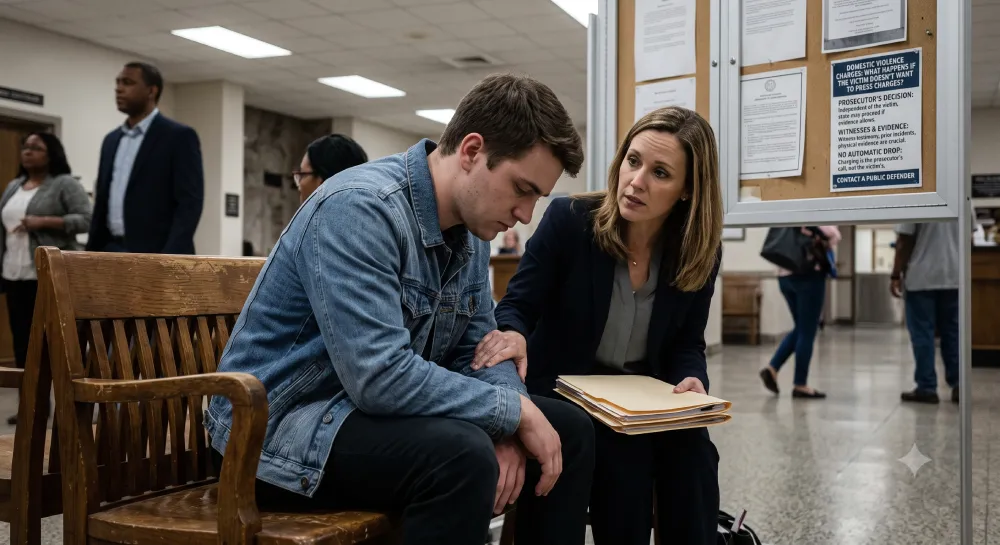
Most people have this completely wrong — and that misunderstanding can cost you everything.
Somebody calls the police. Things calm down. The other person says they don’t want to press charges. They’re not going to cooperate. They’ve told the DA’s office they want the whole thing dropped. And you’re thinking: okay, we’re good. Right? Probably not.
This is one of the most deeply misunderstood areas of criminal law — not just in Greensboro and High Point, but across the entire country. The belief that the “victim” can drop a domestic violence charge is so widespread that people make life-changing decisions based on it. They don’t hire an attorney. They don’t prepare a defense. They assume the case is going away. Sometimes it does. But in North Carolina, it may not. And walking into that situation unprepared is one of the most dangerous things you can do.
The Most Common Myth in Domestic Violence Cases: “If the victim doesn’t press charges, the case gets dropped.” The reality: In North Carolina, the victim does not press charges — the State of North Carolina does. Once the police make an arrest, the decision to prosecute belongs entirely to the District Attorney’s office. The victim’s wishes are one input. They are not the final word.
Key Takeaways — What You Need to Know About NC Domestic Violence Cases Right Now
- In North Carolina, a victim cannot “drop” a domestic violence charge. Only the prosecutor — the District Attorney — has that authority. The State of NC is the party bringing the charge, not the victim.
- Greensboro saw 298 domestic violence-related aggravated assaults through October 2024 — already exceeding all of 2023’s total of 248 (Greensboro Police Department, Oct. 2024).
- North Carolina saw a 69.8% increase in domestic violence-related homicides between 2018 and 2024, with 90 deaths reported in 2024 — the highest in six years.
- In jurisdictions with aggressive DV enforcement, approximately 65-70% of victims do not cooperate with prosecution — yet prosecutors routinely proceed anyway using other evidence.
- 43.9% of women and 19.3% of men in North Carolina report experiencing intimate partner violence in their lifetimes.
- Prosecutors use “evidence-based prosecution” — 911 recordings, body cam footage, photos, medical records, and officer testimony — to build cases without the victim’s active participation.
- A victim who recants or refuses to testify is not necessarily believed. Prosecutors can call the victim to the stand with a subpoena and treat them as a hostile witness.
- Domestic violence convictions in NC carry serious consequences including mandatory protective orders, mandatory firearms surrender, potential federal firearms prohibitions, and loss of custody rights.
- Attorney Micah Huggins handles both the criminal defense side and the family law implications of domestic violence cases — serving clients across Greensboro, High Point, and the entire Triad.
How Serious Is the Domestic Violence Problem in Greensboro and Guilford County — Really?
Key statistics: 298 DV-related aggravated assaults in Greensboro through October 2024 — already above all of 2023 (Greensboro PD / WFMY); 69.8% increase in NC domestic violence-related homicides from 2018 to 2024; 90 domestic violence-related homicides in North Carolina in 2024 — highest in six years; 1,500+ clients served by the Guilford County Family Justice Center in 2023-2024; 43.9% of NC women report experiencing intimate partner violence in their lifetime; and 23% of Greensboro homicides in 2024 were domestic violence-related (GPD).
Those numbers tell you something important about the political and law enforcement climate in Guilford County around domestic violence cases. In 2013 and 2014, Guilford County led the entire state in domestic violence-related homicides. That history shapes how aggressively law enforcement and the District Attorney’s office approach these cases today.
The Guilford County Family Justice Center — a “one-stop shop” staffed by 45 professionals from 14 different disciplines — was built specifically to address this history. It operates in both Greensboro and High Point and helps victims file protective orders, access advocacy services, and interface with law enforcement.
If the Victim Doesn’t Press Charges in North Carolina, Who Actually Controls a Domestic Violence Case?
The short answer: the State of North Carolina. Specifically, the Guilford County District Attorney’s office.
Here’s the fundamental legal reality that most people don’t understand. In the American criminal justice system, crimes are not committed against individual people in the legal sense — they’re committed against the state. When someone calls the police and a domestic violence arrest is made, the case that follows is State of North Carolina v. [Your Name]. Not “Jane Doe vs. John Doe.” The state.
That means:
- The victim did not file the charge — law enforcement did, on behalf of the state
- The victim cannot withdraw or “drop” the charge — they have no legal authority to do so
- The victim can express their wishes to the DA — but that is one factor, not a deciding vote
- The DA can subpoena the victim to testify even if they don’t want to appear
- If the victim recants, the prosecutor may still proceed — and may treat the recantation itself as evidence of coercion
The recantation trap: When a victim later says “I made it up” or “I don’t want to go forward,” experienced domestic violence prosecutors don’t automatically drop the case. They know that recantation is one of the most common patterns in domestic violence situations — often driven by financial dependence, fear, or pressure from the accused. Some prosecutors treat a recantation as evidence that the accused is exerting control over the victim, which can actually make the case against the defendant stronger, not weaker.
According to research on evidence-based prosecution practices, in jurisdictions with aggressive domestic violence enforcement, approximately 65-70% of victims do not cooperate with prosecution — and yet prosecution proceeds in a significant portion of those cases. The legal system has been specifically designed to work around that non-cooperation because it’s so common.
How Do Prosecutors in Guilford County Build a Domestic Violence Case Without the Victim’s Cooperation?
This is the part that most people facing charges never anticipate. Modern domestic violence prosecution is designed around the reality that victims often don’t cooperate. The techniques are well-established, and Guilford County prosecutors are experienced at using them.
The technical term for this approach is “evidence-based prosecution” — sometimes called “victimless prosecution.” The goal is to build a case strong enough to proceed and potentially convict without the victim’s active participation. Here’s the toolkit prosecutors have available:
| Evidence Type | What It Shows | Prosecutorial Weight |
|---|---|---|
| 911 Recording | Victim’s voice in real-time, emotional state, specific descriptions of assault, context | Very strong — contemporaneous statement, often admissible under excited utterance exception |
| Body Camera Footage | Scene conditions, visible injuries, demeanor of both parties, initial statements | Very strong — objective recording, no credibility issues |
| Photographs of Injuries | Physical evidence of harm, location and severity of injuries | Strong — particularly if documented by law enforcement or medical staff |
| Medical Records | Documented injuries, what the victim told medical staff, treatment required | Strong — patient statements to medical providers often admissible |
| Officer Testimony | What the officer observed at the scene — demeanor, injuries, statements made | Strong — officer is available and credible witness |
| Text Messages / Social Media | Prior threats, harassment, documentation of relationship dynamics | Significant — but requires authentication |
| Prior DV History | Pattern of conduct, prior calls to the address, prior charges or protective orders | Significant — courts allow pattern evidence in DV cases |
| Neighbor / Witness Testimony | What bystanders heard or saw | Variable — depends on witness |
| Victim Subpoenaed as Hostile Witness | Compelled testimony; prior inconsistent statements can be introduced | Risky for both sides — but available to prosecution |
| Victim Recantation Itself | May be treated as evidence of coercion or continuing abuse | Double-edged — defense can challenge, but prosecutor may argue intimidation |
The 911 call is the most underestimated piece of evidence in domestic violence cases. When someone calls 911 in distress, what they say is recorded — every word. Under the “excited utterance” exception to the hearsay rule, those statements are frequently admissible in court without the victim testifying. A detailed, emotional 911 call where the caller names the perpetrator and describes specific acts of violence is powerful evidence that doesn’t go away just because the caller later changes their story.
What Are the Actual Charges and Penalties for Domestic Violence in North Carolina in 2025?
North Carolina doesn’t have a single “domestic violence statute.” Instead, it has a set of underlying criminal charges — assault, battery, stalking, harassment, communicating threats — that are enhanced and treated differently when the parties involved have a personal relationship as defined under N.C.G.S. Chapter 50B.
The Underlying Criminal Charges
The most common domestic violence charges in Guilford County courts include:
- Simple Assault (Class 2 Misdemeanor) — Physical contact or the threat of harm
- Assault on a Female (Class A1 Misdemeanor) — When the defendant is male and the victim is female; one of the most commonly charged DV offenses in NC
- Assault Inflicting Serious Injury (Class A1 Misdemeanor) — Assault resulting in significant physical harm
- Assault with a Deadly Weapon (Class A1 Misdemeanor to Class E Felony) — Depends on intent and injury
- Communicating Threats (Class 1 Misdemeanor) — Verbal or written threats placed the victim in fear
- Stalking (Class A1 Misdemeanor / Class F Felony for repeat)
- Violation of Domestic Violence Protective Order (Class A1 Misdemeanor) — Mandatory arrest required under N.C.G.S. section 50B-4.1
What makes a charge “domestic violence” in NC: The domestic relationship, not the act itself, is what triggers enhanced DV treatment. Under N.C.G.S. section 50B-1, covered relationships include: current and former spouses, current and former dating partners, persons who share or have shared a residence, persons of the opposite sex in a current or former dating relationship, and persons who share a child in common.
The Domestic Violence Protective Order (50B) — Separate From the Criminal Case
While the criminal case moves through Superior or District Court, the alleged victim can simultaneously file for a Domestic Violence Protective Order (DVPO) — also called a “50B order” — in civil court. These are two completely separate tracks. The civil protective order proceeding operates on a lower “preponderance of the evidence” standard, not the criminal “beyond reasonable doubt” standard. An ex parte (emergency) order can be issued same-day and take effect immediately, before you’ve had any opportunity to respond.
A DVPO can order you out of your home, restrict your contact with your children, and require you to surrender all firearms. Violating a valid DVPO is a mandatory arrest situation under North Carolina law — the officer must arrest if they have probable cause to believe a violation occurred, regardless of the victim’s wishes at that moment. And under federal law, being subject to a qualifying protective order may also prohibit firearm possession under the Gun Control Act.
The firearms consequence that nobody tells you about: A domestic violence conviction — even a misdemeanor — triggers a lifetime federal prohibition on firearm possession under 18 U.S.C. section 922(g)(9), the Lautenberg Amendment. This is not just a North Carolina consequence. It is federal law. It applies to hunters, sportsmen, law enforcement officers, and anyone else who owns or plans to own firearms. A misdemeanor domestic violence conviction that “seemed minor” at the time can permanently end your right to own a gun. This is one of the most severe collateral consequences of a DV conviction in America.
What Are the Actual Defense Strategies in a Domestic Violence Case Where the Victim Doesn’t Cooperate?
If you’re facing a domestic violence charge in Greensboro or High Point — and the alleged victim has told people they don’t want to go forward — your defense strategy is not “wait and see.” That’s how cases become convictions. Here’s what experienced defense representation actually looks like in this situation.
- Get involved immediately — before arraignment. The earlier an attorney is involved, the more options remain available. In the period between arrest and arraignment, important conversations happen — between the victim’s family and the DA, between law enforcement and prosecutors, between various agencies. An attorney who is already in the picture can shape those conversations before positions become locked in.
- Challenge the evidence directly. Every piece of evidence in the prosecution’s file gets scrutinized. Was the 911 call properly authenticated? Does the body camera footage actually show what the state claims? Were the photos taken immediately — or after the scene had been altered? Are the medical records consistent with the allegations? Evidence that looks overwhelming on a charging document often has real vulnerabilities on close examination.
- Examine the context of the alleged victim’s non-cooperation. A victim choosing not to cooperate for genuine reasons — not coercion, but honest reconsideration — is meaningfully different from a case where coercion is alleged. Your attorney develops the full context: the nature of the relationship, the victim’s reasons for not wanting to proceed, any documentation that supports an alternative account of what happened.
- Explore self-defense and mutual combat issues. In domestic situations, physical altercations are frequently not one-sided. North Carolina law recognizes self-defense, and in cases where both parties were engaged in physical contact, the question of who was the “primary aggressor” becomes central. An experienced attorney investigates this thoroughly.
- Negotiate intelligently with the DA’s office. In Guilford County, negotiated resolutions often look like: a charge reduction from a Class A1 to a lesser misdemeanor, a deferred prosecution agreement conditioned on completing a batterer’s intervention program, or a dismissal after a period of no further contact or incidents. The leverage for that negotiation comes from demonstrating the weaknesses in the prosecution’s evidentiary position.
- Address the protective order track simultaneously. The civil DVPO proceeding and the criminal case run on parallel tracks, but they affect each other. An attorney who handles both — like the Huggins Law Firm, which practices both criminal defense and family law — can coordinate the strategy across both proceedings. What happens in one courtroom can affect what happens in the other, and your children’s custody and your home access may be directly at stake.
“We don’t just file motions or show up in court. We fight with strategy, we counsel with empathy, and we work to restore what’s been lost — dignity, stability, or peace of mind.” — Attorney Micah E. Huggins, Huggins Law Firm, P.C.
How Does a Domestic Violence Charge in NC Affect Your Family Law Case — Child Custody and Divorce?
This is where the stakes get even higher, and where having an attorney who handles both criminal defense and family law is genuinely invaluable.
In North Carolina family court, domestic violence findings are taken extremely seriously. Under N.C.G.S. section 50-13.2, when a court finds that domestic violence has occurred, it creates a rebuttable presumption — meaning a legal starting assumption — that awarding custody to the perpetrator is not in the best interests of the child. That’s a significant legal hurdle to overcome.
A criminal domestic violence conviction also directly impacts:
- Custody and visitation rights — judges consider DV convictions in all custody determinations
- Your ability to have unsupervised parenting time during an active protective order
- The terms of any divorce settlement where domestic violence is alleged as grounds
- Your ability to remain in the marital home while a DVPO is in effect
At Huggins Law Firm, Attorney Huggins handles both the criminal side and the family law implications of these cases. Our family law practice is built around exactly these intersections — because the person charged with a DV offense isn’t just fighting a criminal case. They’re often fighting for their marriage, their children, and their home simultaneously.
Do not navigate both proceedings alone or with separate attorneys who aren’t talking to each other. Statements made in the civil protective order hearing can be used in the criminal case. Decisions made in the criminal case can affect protective order proceedings. The two tracks need a coordinated strategy — not two separate strategies that may inadvertently contradict each other.
10 Questions North Carolinians Ask About Domestic Violence Charges and What Happens in Court
1. Can the victim drop domestic violence charges in North Carolina? No — not directly. The victim did not file the charges and has no legal authority to withdraw them. In North Carolina, domestic violence charges are brought by the State of North Carolina through the District Attorney’s office. The victim can communicate their wishes to the DA — and that input matters — but the DA has sole authority over whether to proceed. In cases with strong physical evidence, 911 recordings, and documented injuries, prosecutors frequently proceed even without victim cooperation.
2. What happens if the victim recants their statement in a North Carolina domestic violence case? Recantation is extremely common in domestic violence cases — prosecutors know this and have procedures for dealing with it. If a victim recants, the prosecutor may: proceed using the original statement along with other physical evidence; call the victim as a witness using a subpoena; treat the recantation as potential evidence of intimidation or coercion by the accused; or compare the recanted statement to the original 911 call and body camera footage for inconsistencies.
3. What is a Domestic Violence Protective Order (50B) in North Carolina and how quickly can it be issued? A 50B DVPO is a civil court order issued under N.C.G.S. Chapter 50B that restricts the respondent’s conduct — prohibiting contact, requiring them to leave a shared residence, restricting access to children, and mandating surrender of firearms. An emergency ex parte order can be issued the same day a petition is filed, without the respondent present or notified. It takes effect immediately and lasts until a hearing, typically within 10 days. After a full hearing, a final DVPO can last up to one year and be renewed.
4. What are the consequences of a domestic violence conviction in North Carolina beyond jail time? A domestic violence conviction — even a misdemeanor — carries consequences that extend far beyond the courtroom: (1) A lifetime federal prohibition on firearm ownership under the Lautenberg Amendment; (2) Mandatory issuance or continuation of a protective order; (3) Significant impact on child custody determinations; (4) Potential deportation for non-citizens; (5) Employment consequences; (6) Loss of housing if the conviction triggers lease violations.
5. Can I be arrested for domestic violence even if nothing physical happened? Yes. North Carolina’s domestic violence statutes cover more than physical assault. Communicating threats — telling someone you’re going to harm them in a way that places them in reasonable fear — is a criminal charge under N.C.G.S. section 14-277.1. Stalking, harassment, and repeated unwanted contact can also support domestic violence charges. Physical injury is not a prerequisite for arrest or prosecution in North Carolina.
6. What does Guilford County’s Family Justice Center mean for my domestic violence case? The Guilford County Family Justice Center — which operates in both Greensboro and High Point — is a coordinated multi-agency hub with 45 professionals from 14 disciplines working together to support victims and facilitate prosecution. From a defense standpoint, this means your case will be handled by a well-organized, well-resourced support system for the prosecution side. Understanding this infrastructure — and having an attorney who knows how it operates — is part of navigating Guilford County DV cases effectively.
7. How does a domestic violence charge affect child custody in North Carolina? Very significantly. Under N.C.G.S. section 50-13.2, if a court finds that domestic violence has occurred, there is a legal presumption against awarding custody to the perpetrator. That presumption can be rebutted, but it requires affirmative evidence that the custody arrangement will be safe and in the child’s best interest. An active DVPO will typically restrict the respondent’s access to the children during its duration. This is a core reason why challenging the charge — rather than accepting any plea — can be critically important for parents.
8. Can I be charged with domestic violence for an incident that happened years ago in North Carolina? In North Carolina, misdemeanor charges generally carry a 2-year statute of limitations from the date of the offense. Felony charges typically have no statute of limitations for the most serious offenses. More practically, a prior history of domestic violence incidents — even uncharged ones — can be introduced as pattern evidence in a current case under certain circumstances.
9. What happens at a first appearance after a domestic violence arrest in Guilford County? At your first appearance, the magistrate or judge will review the charges and set conditions of release. In domestic violence cases, conditions almost always include a no-contact order with the alleged victim — meaning you cannot call, text, email, or appear at their location regardless of their stated wishes. Violating those conditions while the case is pending can result in immediate bond revocation and additional charges.
10. Should I represent myself in a domestic violence case if the victim doesn’t want to proceed? Emphatically, no. The belief that a non-cooperative victim means you don’t need a lawyer is exactly the thinking that leads to convictions no one saw coming. Prosecutors in Guilford County are experienced with evidence-based prosecution. The collateral consequences of a DV conviction — federal firearm prohibition, custody impact, employment consequences — are permanent. Call Huggins Law Firm before you say anything to anyone about the case.
This page is for general informational purposes only and does not constitute legal advice. Contact Attorney Micah Huggins for advice specific to your situation. If you or someone you know is in danger, please call 911 or the National DV Hotline: 1-800-799-7233. Serving Greensboro, High Point, Graham, Burlington, Asheboro, Kernersville, and Winston-Salem.