
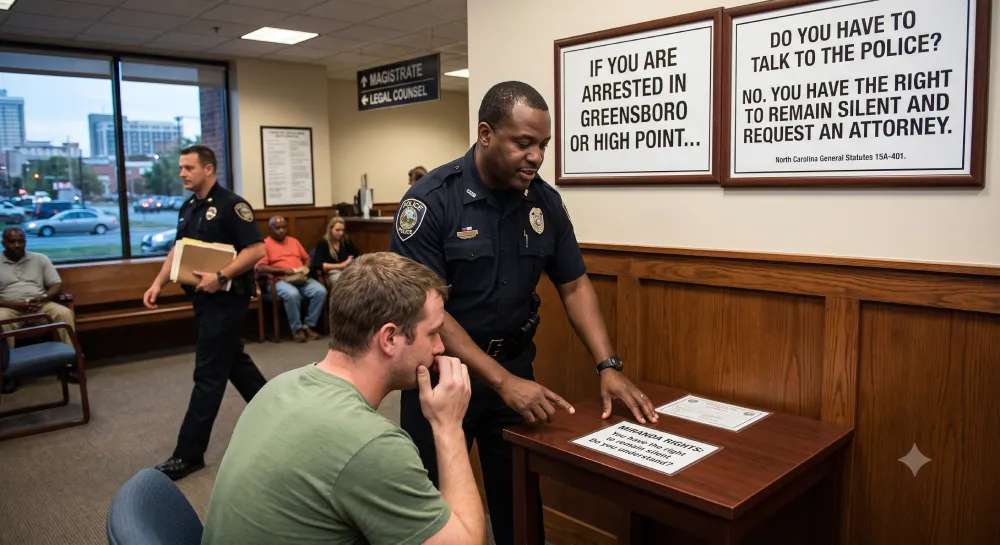
Do I Have to Talk to the Police If I’m Arrested in Greensboro or High Point, NC?
The short answer is no — and knowing that one fact could be the most important thing that ever happens to you.
Key Takeaways — Read This First
- You are never required to answer police questions after an arrest. The Fifth Amendment protects you.
- Say only two things: “I am invoking my right to remain silent” and “I want a lawyer.”
- Anything you say — even something that sounds harmless — can and will be used against you in court.
- Guilford County (home of Greensboro and High Point) handles tens of thousands of criminal cases every single year. The system moves fast.
- Studies show that innocent people confess to crimes they didn’t commit in roughly 25-30% of wrongful conviction cases — often because they kept talking without a lawyer present.
- Attorney Micah Huggins has spent over a decade defending the accused in Greensboro, High Point, and across the Piedmont Triad.
Picture this. You’re sitting in the back of a police car. Your heart is pounding. An officer looks at you in the rearview mirror and says, “Just tell us your side of the story and we can probably work something out.”
It sounds reasonable, right? Like the right thing to do would be to just explain yourself.
Here’s the truth that most people don’t find out until it’s too late: that moment — right there — is one of the most dangerous moments of your entire case.
You do not have to talk to the police if you are arrested. Period. Not in Greensboro. Not in High Point. Not anywhere in North Carolina. The Fifth Amendment to the United States Constitution gives you the absolute right to remain silent, and that right exists for a very good reason: talking to the police without a lawyer almost never helps you, and it very often destroys your case.
What Exactly Is the Right to Remain Silent — and Where Does It Come From?
The Fifth Amendment says that no person “shall be compelled in any criminal case to be a witness against himself.” In plain English: the government cannot force you to say something that could get you in trouble.
You’ve probably heard “Miranda rights.” It comes from the 1966 Supreme Court case Miranda v. Arizona, which ruled that police must inform you of your right to remain silent and your right to have an attorney before they question you. (Source: Oyez / U.S. Supreme Court)
But here’s something a lot of people miss: you don’t have to wait for police to read you your Miranda rights before you exercise them. You can — and should — invoke your right to remain silent the moment you are detained or arrested, whether they’ve said those words or not.
According to the Innocence Project, false confessions have played a role in approximately 29% of all wrongful conviction cases in the United States where DNA evidence later exonerated the defendant. In many of those cases, the person simply kept talking — without a lawyer — because they thought being cooperative would help them.
What Should You Actually Say If You’re Arrested?
Here’s what you say — and you keep it simple:
“I am invoking my right to remain silent. I want a lawyer.”
That’s it. Say those two sentences. Then stop talking. Don’t elaborate. Don’t explain why you want a lawyer. Don’t say “I didn’t do anything wrong” right after. Just stop.
After you invoke your right to counsel, police are legally required to stop questioning you until your attorney is present. (Edwards v. Arizona, 451 U.S. 477)
A lot of people worry that staying silent will make them look guilty. It won’t. Juries are instructed by judges that they cannot draw any negative conclusion from the fact that you exercised your constitutional rights.
Why Is This Such a Big Deal in Guilford County Specifically?
Guilford County — which includes both Greensboro and High Point — is one of the largest and busiest court jurisdictions in North Carolina. This isn’t a small-town courthouse. With a population of approximately 545,000 people (U.S. Census Bureau, 2023), making it the third most populous county in North Carolina, the court system processes hundreds of thousands of case filings annually.
When a case moves through a system this large and this fast, what you said — or didn’t say — in those first hours can set the entire tone of your prosecution. Prosecutors look at police reports. They look at statements. If you gave a statement that contradicts something later found on video or in physical evidence, that inconsistency becomes ammunition against you.
Common Scenarios — DWI Stops, Domestic Calls, Traffic Stops
DWI Stops in Guilford County
North Carolina has an “implied consent” law, which means by driving on NC roads, you’ve already consented to a chemical test (breathalyzer or blood test) if lawfully arrested for DWI. However, that is very different from answering officer questions about how much you had to drink. You are not required to answer those questions.
Domestic Violence Calls
When police respond to a domestic call, emotions are high and everyone wants to tell their side of the story. Resist that urge. In North Carolina, even if the alleged victim doesn’t want to press charges, the state can still prosecute. What you said in those first frantic minutes will be in the police report. Keep quiet and call Huggins Law Firm immediately.
Being Stopped and Questioned (Not Yet Arrested)
You have the right to remain silent before an arrest — with one key difference. You do have to provide your name in North Carolina if police have reasonable suspicion. Beyond your name, you are not required to answer other questions.
Why Statements Are Especially Dangerous by Crime Type
| Crime Type | Why Statements Are Especially Dangerous |
|---|---|
| Drug Offenses | Admissions about “whose drugs they were” or “I was holding them for someone” devastate your case |
| DWI / DUI | Statements about how much you drank are used directly as evidence |
| Domestic Violence / Assault | Explaining what happened, even innocently, often creates contradictions with the alleged victim’s account |
| Theft / Larceny | Trying to explain why you had certain property almost always backfires |
| Weapons Charges | Any statement about knowledge of, or access to, a weapon is immediately used against you |
| Traffic Offenses / Hit and Run | Statements at the scene are often the only evidence beyond physical damage |
The Innocent People Who Talked — And What It Cost Them
Innocent people confess to crimes they didn’t commit. Regularly. The Innocence Project reports that false confessions contributed to wrongful convictions in approximately 1 in 4 cases where DNA later proved innocence. (Innocence Project)
Why does this happen? Interrogations can last many hours. Officers may suggest (sometimes falsely) that evidence already exists against you — they are legally allowed to lie during questioning. People want to be seen as cooperative. Young people and people with mental health challenges are especially vulnerable.
What Happens After You Invoke Your Rights — The Process in Guilford County
- You are processed (booked). Fingerprints, photograph, records check at the Guilford County Detention Center. You do not have to answer questions beyond basic identifying information.
- Bail / Bond Hearing. You’ll appear before a magistrate judge. Having an attorney at this stage can make a real difference in whether you go home or spend days waiting in a cell.
- First Appearance / District or Superior Court. Depending on whether you’re charged with a misdemeanor or felony. Attorney Huggins practices regularly in both.
10 Most Common Questions People Ask Criminal Defense Lawyers in North Carolina
1. Do I have to talk to the police if I’m arrested in North Carolina? No. You have the right under the Fifth Amendment to remain silent. Clearly state that you are invoking your right and that you want a lawyer. Then say nothing more.
2. What happens if I can’t afford a lawyer in Guilford County? You have the right to a court-appointed attorney. However, public defenders carry very large caseloads. If you can hire private counsel, the level of individual attention can make a significant difference.
3. Will I go to jail for a first-time offense in North Carolina? It depends on the charge. Many first-time, non-violent offenders may be eligible for community service, probation, deferred prosecution, or diversion programs.
4. How long does a criminal case take to resolve in Guilford County? Misdemeanor cases can sometimes resolve in a few months. Felony cases often take a year or more.
5. Can I get a criminal charge expunged in North Carolina? Yes, in many cases. North Carolina expanded its expungement laws in recent years. Contact Huggins Law Firm to find out if you qualify.
6. What is the difference between a misdemeanor and a felony in NC? Misdemeanors are less serious (Class A1-3, up to 150 days jail). Felonies are more serious (Class A-I, up to life in prison). Felonies carry permanent consequences including loss of voting and firearm rights.
7. Can the police search my car or home without a warrant? Generally, no for your home. For vehicles, there are more exceptions. If you believe a search was illegal, your attorney can file a motion to suppress.
8. What should I do if I’m accused of domestic violence? Do not contact the alleged victim. Do not make any statements to police. Contact a criminal defense attorney immediately.
9. How does a DWI conviction affect my life in NC? License revocation, fines, mandatory substance abuse assessment, jail time, and a permanent criminal record. Fighting the charge with an experienced attorney is almost always worth it.
10. If I’m innocent, shouldn’t I just cooperate and tell the truth? This is the most common and most dangerous misconception. The justice system is not designed to figure out whether you’re telling the truth during an interrogation — it’s designed to build a case. Even truthful statements can be misquoted, taken out of context, or used against you. Always speak to an attorney first. Huggins Law Firm can help you tell your story safely and strategically.
This page is for general informational purposes only and does not constitute legal advice. Contact Attorney Micah Huggins for advice specific to your situation. Serving Greensboro, High Point, Graham, Burlington, Asheboro, Kernersville, and Winston-Salem.