
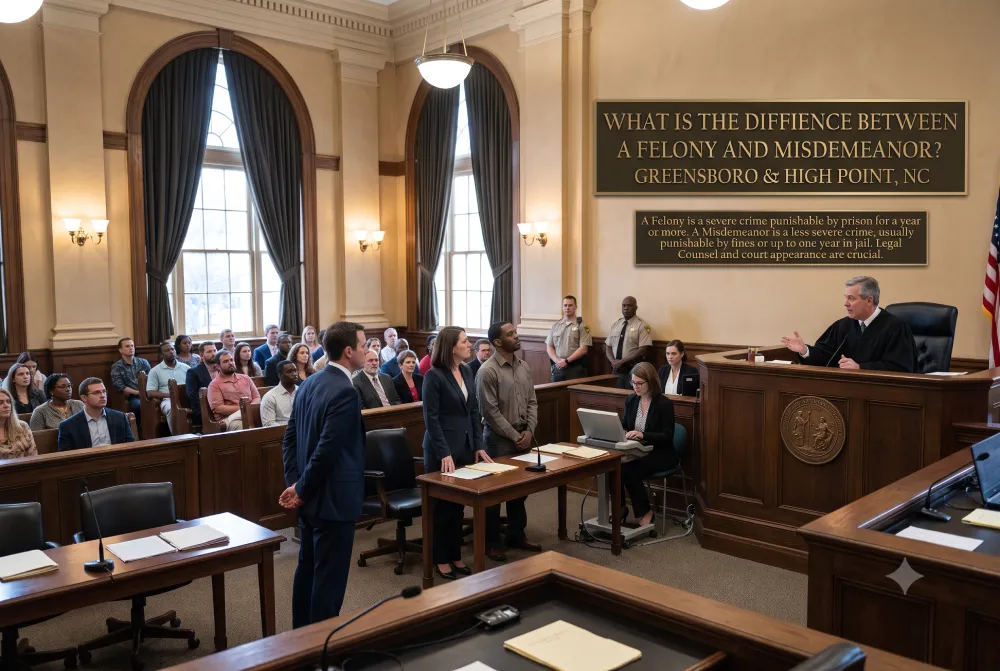
What’s the Real Difference Between a Felony and a Misdemeanor in NC — and Why Does It Matter So Much in Greensboro and High Point?
One carries a fine and maybe a few days in jail. The other can cost you your right to vote, your right to own a firearm, and years of your life. Knowing which one you’re facing — and what to do about it — could change everything.
Key Takeaways — Start Here
- North Carolina has two main categories of criminal charges: misdemeanors and felonies. They are not the same, and the gap between them is enormous.
- Misdemeanors range from Class 3 (least serious) to Class A1 (most serious) and can carry up to 150 days in jail.
- Felonies range from Class I (least serious) to Class A (most serious — first-degree murder) and can carry decades or even life in prison.
- A felony conviction in NC means loss of voting rights, loss of firearm rights, and a permanent mark on your record that can affect housing, jobs, and professional licenses for the rest of your life.
- Guilford County — home of Greensboro and High Point — is one of the highest-volume criminal court jurisdictions in North Carolina.
- Many charges that look like one thing can be negotiated or challenged with the right legal strategy. Attorney Micah Huggins has spent over a decade doing exactly that in these courts.
Let’s be honest about something. When most people hear they’ve been charged with a crime, their brain kind of goes blank. The officer is talking, the handcuffs are on or just came off, and everything sounds like noise. Then someone eventually says the word “felony” — or maybe “just a misdemeanor” — and you’re supposed to know what that means for your life. Most people don’t.
This article breaks down the difference in plain language. We’ll look at the real numbers — what kinds of charges come through Greensboro and High Point courts every year, what the consequences actually look like, and why having an experienced attorney at Huggins Law Firm, P.C. in your corner from day one can genuinely change the outcome of your case.
How Does North Carolina Actually Classify Criminal Charges?
North Carolina uses a structured classification system. The system is split into two main buckets: misdemeanors and felonies. Within each bucket, there are classes that determine the range of punishment.
Misdemeanor Classes (Least to Most Serious)
- Class 3 — Least serious. Fine up to $200, up to 20 days jail.
- Class 2 — Fine up to $1,000, up to 60 days jail.
- Class 1 — Up to 120 days jail.
- Class A1 — Most serious misdemeanor. Up to 150 days jail.
Felony Classes (Least to Most Serious)
- Class I — 3-12 months.
- Class H — 4-25 months.
- Class G — 8-31 months.
- Class F — 10-41 months.
- Class E — 15-63 months.
- Class D — 38-160 months.
- Class C — 44-182 months.
- Class B2 — 94-393 months.
- Class B1 — 144 months to life.
- Class A — Life without parole or death.
These ranges aren’t random. North Carolina uses a Structured Sentencing system, meaning judges don’t have unlimited discretion — the sentence range is determined by both the class of the crime and the defendant’s prior criminal record level. (N.C. General Statutes, Chapter 15A)
Under NC’s system, even a single prior conviction can move you from one “Prior Record Level” to the next, adding months or years to the presumptive sentence range. The jump from Level I to Level II to Level III can mean the difference between probation and active prison time on the very same charge.
Common Misdemeanor Charges in Greensboro and High Point
| Misdemeanor Charge | NC Class | Maximum Jail Time |
|---|---|---|
| Simple Assault | Class A1 or Class 2 | 60-150 days |
| Assault on a Female | Class A1 | 150 days |
| DWI (Impaired Driving) | Separate structured levels (1-5 and Aggravated Level 1) | Up to 3 years (Agg. Level 1) |
| Larceny (under $1,000) | Class 1 | 120 days |
| Misdemeanor Drug Possession | Class 1 or 3 | Up to 120 days |
| Communicating Threats | Class 1 | 120 days |
| Driving While License Revoked | Class 3 or 1 | Up to 120 days |
Even though misdemeanors are technically “less serious,” a misdemeanor conviction can still wreck your life. It shows up on background checks. It can cost you a job offer. It can affect professional licensing. And in immigration proceedings, even a misdemeanor can have catastrophic consequences for non-citizens.
Common Felony Charges in Guilford County
| Felony Charge | NC Class | Key Consequences |
|---|---|---|
| Felony Larceny / Breaking and Entering | Class H or I | Active prison time, permanent record |
| Felony Drug Possession / Trafficking | Class G through Class C | Mandatory minimums for trafficking; permanent record |
| Assault Inflicting Serious Injury / AWDW | Class F or E | Prison, loss of firearm rights |
| Robbery with Dangerous Weapon | Class D | 38-160 months active prison |
| Sexual Assault / Rape | Class B1 or C | Decades in prison, sex offender registration |
| First-Degree Murder | Class A | Life without parole or death penalty |
| Possession of Firearm by Felon | Class G | Prison — prior felony compounds stakes |
What Does a Felony Conviction Actually Cost You Beyond Prison Time?
- Loss of Voting Rights. You cannot vote while serving an active sentence, on probation, or on parole. Rights restored only after full completion of sentence. (NC State Board of Elections)
- Loss of Firearm Rights. Under both federal law (18 U.S.C. section 922(g)) and North Carolina law (N.C. Gen. Stat. section 14-415.1), any felony conviction permanently prohibits firearm possession — including non-violent felonies.
- Employment Consequences. A felony conviction can disqualify you from government jobs, federal contracting positions, jobs requiring professional licenses, and most private-sector positions that run background checks.
- Housing Consequences. Landlords in NC are generally permitted to reject rental applications based on criminal history. Many federally assisted housing programs automatically disqualify people with certain felony drug convictions.
- Immigration Consequences. For non-citizens, a felony conviction can trigger deportation proceedings, denial of naturalization, or inadmissibility.
- Loss of Professional Licenses. Teachers, nurses, physicians, attorneys, real estate agents, contractors, and dozens of other professionals are required to disclose felony convictions to their licensing boards.
The Sentencing Project’s 2022 report estimated that approximately 56,000 North Carolina residents were disenfranchised due to a felony conviction at the time of the report.
Can a Felony Charge Be Reduced to a Misdemeanor in North Carolina?
Yes, sometimes it absolutely can. But only with the right legal representation, timing, and strategy.
- Plea Negotiations: A skilled defense attorney can present mitigating factors and negotiate a plea to a lesser charge. A Class H felony reduced to a Class 1 misdemeanor means the difference between a felony record and a misdemeanor.
- Pre-Trial Motions: If evidence was obtained unlawfully — through an illegal search, improper stop, or Miranda violation — your attorney can file a motion to suppress. If the evidence gets thrown out, the entire case can collapse.
- Deferred Prosecution / Diversion Programs: NC allows certain first-time offenders to participate in diversion programs. Completing the program can result in charges being dismissed and potentially eligible for expungement.
- Challenging the Charge Classification: Some charges hinge on specific thresholds — dollar amounts for theft, weight for drug charges, prior record calculations. An attorney reviews all of this for inaccuracies.
“We don’t just file motions or show up in court. We fight with strategy, we counsel with empathy, and we work to restore what’s been lost — dignity, stability, or peace of mind.” — Huggins Law Firm, P.C.
What About Expungement — Can a Felony or Misdemeanor Be Removed From Your Record?
North Carolina significantly expanded its expungement laws in recent years. Today, more people are eligible than ever before. Dismissed charges and not-guilty verdicts are generally eligible immediately. Many misdemeanor convictions are eligible after a 5-year waiting period. Some non-violent Class H and Class I felony convictions may be eligible after 10 years. First-time juvenile and young adult offenses have additional expungement pathways.
An expungement can restore employment opportunities, improve housing access, and give you back a clean slate. Contact Huggins Law Firm to find out if your record may be eligible for expungement under current NC law.
10 Questions People Ask About Felonies and Misdemeanors in NC
1. What’s the difference between a felony and a misdemeanor in NC? Misdemeanors are classified Class A1, 1, 2, or 3 (max 150 days jail). Felonies are Class A through I (up to life in prison). Felonies carry permanent consequences including loss of voting and firearm rights.
2. Will I go to prison if this is my first felony? Not necessarily. NC’s Structured Sentencing system gives judges discretion to impose probation for many first-offense, lower-class felonies (Class H and I).
3. Can a felony charge be reduced to a misdemeanor in Guilford County? Yes, in many cases, through plea negotiations, pre-trial motions, or diversion programs.
4. Does a misdemeanor show up on a background check? Yes. Both misdemeanor and felony convictions appear on standard criminal background checks in NC.
5. Can I own a gun after a felony conviction? No. A felony conviction permanently prohibits firearm possession under both state and federal law.
6. How long does a felony case take in Guilford County Superior Court? Typically several months to two years or more, depending on complexity.
7. Can I get a felony expunged in NC? Some non-violent Class H and I felonies are eligible after a 10-year waiting period.
8. What happens to my voting rights after a felony conviction? You lose the right to vote until you’ve completed your full sentence and any supervised release.
9. What is a Class A1 misdemeanor? The most serious misdemeanor in NC. Includes assault on a female, assault inflicting serious injury, and stalking. Up to 150 days in jail.
10. Should I hire a private attorney or use a public defender? Public defenders are dedicated but carry heavy caseloads. Private counsel can typically offer more individual attention and faster communication. Huggins Law Firm offers free consultations.
This page is for general informational purposes only and does not constitute legal advice. Contact Attorney Micah Huggins for advice specific to your situation. Serving Greensboro, High Point, Graham, Burlington, Asheboro, Kernersville, and Winston-Salem.