
Key Takeaways
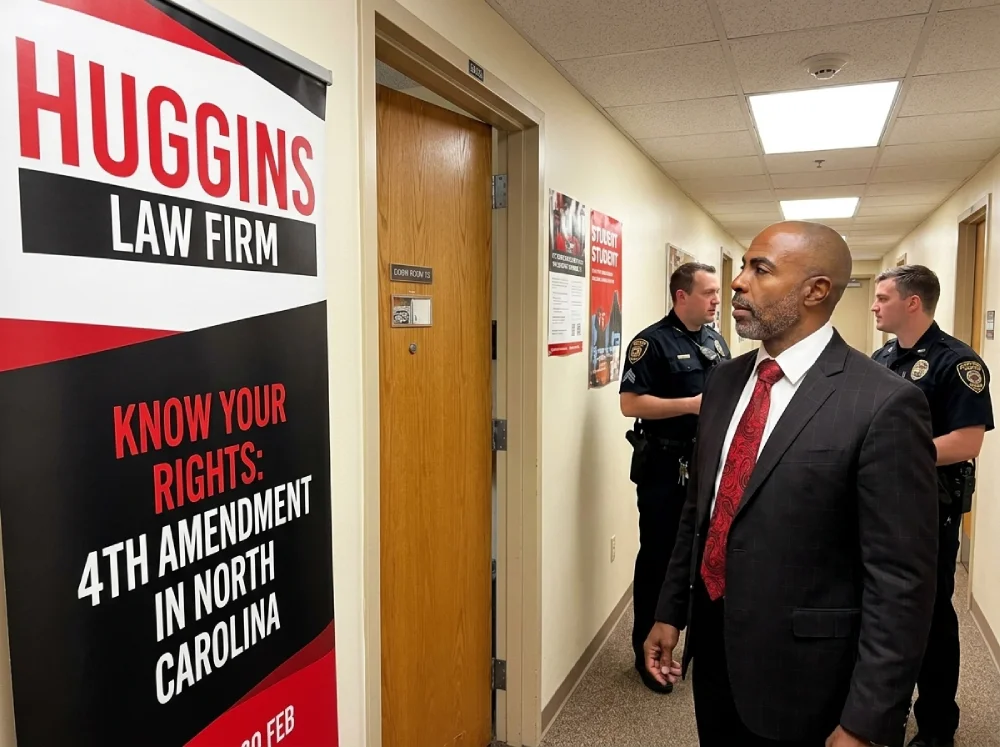
- Your Dorm is Your Home: You have Constitutional rights in your dorm room. The 4th Amendment protects you from illegal police searches.
- RAs vs. Police: A Resident Advisor (RA) can inspect your room for school rules. But Campus Police are real, sworn police officers. They usually need a warrant to search for a crime.
- Never Give Consent: If police knock on your dorm door, step outside and close the door behind you. You have the right to politely say, “I do not consent to a search.”
- Drug and Alcohol Charges are Common: In Greensboro and High Point, hundreds of students are caught with drugs and alcohol every year.
- We Protect Your Future: A college mistake should not ruin your life. Huggins Law Firm knows how to fight illegal dorm searches and keep your record clean.
Going off to college is an amazing time. You finally have your own space. But living in a dorm room can also be very confusing when it comes to your privacy. What happens if the school or the police want to search your room?
Hello! My name is Attorney Micah Huggins. We have been in business for over a decade, and we are very highly rated and have won multiple awards. The name of my firm is Huggins Law Firm, P.C. and we proudly represent the accused in Greensboro, Graham, Burlington, Asheboro, High Point, Kernersville, and Winston-Salem.
Some other info about us: Justice with Integrity. Representation with Heart. At Huggins Law Firm, we believe that great representation goes beyond knowing the law — it’s about standing up for people when the stakes are high, when the odds are heavy, and when the system feels overwhelming. Founded by me, Attorney Micah E. Huggins, the firm was built on a simple conviction: every client deserves clarity, compassion, and a champion in their corner. Whether it’s a criminal defense case, a Family Law matter, or a complex civil dispute like Personal Injury, we bring the same level of preparation, precision, and purpose to every case we handle.
We don’t just file motions or show up in court. We fight with strategy, we counsel with empathy, and we work to restore what’s been lost — dignity, stability, or peace of mind. We also represent clients in Estate Planning to protect your family’s future.
Today, we are answering a huge question for college students and their worried parents. If you live on campus, can the police just walk into your room and search your stuff? Let’s break down the law so you know your rights.
How Does the 4th Amendment Apply to University Housing Contracts?
When you move into a dorm at a school like UNC Greensboro or High Point University, you sign a housing contract. This is a big packet of papers.
In that contract, you agree that the school can enter your room for certain reasons. They can come in to fix a broken pipe. They can come in to do a routine safety check during winter break.
Because of this contract, many students think they have zero privacy. But that is not true! The United States Constitution has the 4th Amendment. The 4th Amendment says the government cannot search your home unreasonably. The courts in North Carolina agree that a college dorm room is your legal home while you live there.
A housing contract does not cancel out the Constitution.
Can an RA Search My Dorm Room Without a Warrant?
Yes, but only for school rules.
A Resident Advisor (RA) or a Hall Director is an employee of the university. They are not police officers. If an RA smells smoke or hears a loud party, they can knock on your door and come inside. They can look around to see if you are breaking the housing contract rules.
If an RA sees a bottle of alcohol or drug items out in the open, they can write you up for a disciplinary hearing with the school. But an RA usually cannot force you to unlock your personal safe or dig through your closed drawers.
Do Campus Police Need a Warrant to Search a Dorm Room in NC?
Yes! This is the most important part to remember.
In North Carolina, campus police officers at public schools (like UNCG) and private schools (like High Point University) are fully sworn, real law enforcement officers. They have badges, guns, and the power to arrest you. They are not just security guards.
Because they are real police, they have to follow the rules of criminal law. To search your dorm room for a crime, Campus Police usually need one of three things:
- A Search Warrant: A piece of paper signed by a judge saying they have proof a crime is happening in your room.
- Consent: You give them permission to come in and look around.
- An Emergency (Exigent Circumstances): They hear someone screaming for help inside, or they actually see you destroying evidence through the window.
If campus police try to use the school’s “maintenance” rule just to sneak into your room and look for drugs, they are breaking the law. A good lawyer can get that evidence thrown in the trash!
What Are the Most Common Dorm Room Crimes in Greensboro and High Point?
College campuses are like small cities. To see what the police are looking for, we can look at the real numbers.
Very few people talk about this, but every college is required by federal law (the Jeanne Clery Act) to report their crime statistics to the government. We can see exactly what is happening in the dorms.
According to recent Clery Act data from the National Center for Education Statistics (NCES), drug abuse and liquor law violations are the biggest issues on college campuses.
- At High Point University, the Annual Security Report recently showed well over 100 disciplinary actions for drug abuse and liquor law violations in a single year.
- At UNC Greensboro, campus security deals with hundreds of reports of drug and alcohol violations in the residence halls every single year.
- Nationwide, burglaries and motor vehicle thefts are also highly reported on campuses, leading police to constantly patrol parking lots and dorm buildings.
Because drugs and alcohol are so common, campus police are always sniffing the hallways. If they smell marijuana coming from your door, they will knock.
What Should You Do If Campus Police Knock on Your Door?
If there is a loud knock and someone yells “Campus Police!”, your heart will race. But you must stay calm and remember your rights.
Step 1: Step outside. Open the door just enough to step into the hallway, and pull the door shut behind you until it clicks. Do not leave the door wide open! If the door is open and the police see something illegal from the hallway, they can walk right in.
Step 2: Be polite but firm. The officer might say, “We had a complaint about a smell. Can we just take a quick look around your room?”
Step 3: Say NO. You must say, “I am sorry officer, but I do not consent to a search.”
The officer might threaten you. They might say, “If you don’t let us in, we will go get a warrant, and it will be much worse for you.” Let them go get a warrant! Never give them permission to search. Make them do the hard work. If they go get a warrant, we can fight the warrant in court later.
How Can Attorney Micah Huggins Protect Your College Future?
If the police searched your dorm and arrested you, you are facing two huge problems. First, you face real criminal charges in the Guilford County court system. Second, you face a student conduct hearing at your university, which could kick you out of school.
You need a champion. At Huggins Law Firm, we jump into action.
We look at the police report very closely. Did the campus police force their way into your room without a warrant? Did you say “no,” but they searched anyway? If the police violated your 4th Amendment rights, we will file a motion in court to suppress (throw out) the evidence. If the drugs are thrown out, the case is usually dismissed!
We know how hard you worked to get into college. We counsel you with empathy. We fight to keep your record clean so you can graduate and get a great job.
10 of the Most Common Questions Asked About Dorm Room Searches in NC
When terrified students and parents call our office, they ask a lot of questions. Here are the top ten questions about college dorm searches, answered in plain English.
1. Does my roommate giving consent mean the police can search my stuff?
If your roommate says “yes” to the police, the police can search the common areas (like the shared living room or bathroom). They can also search your roommate’s side of the room. But they usually cannot search your private closet, your safe, or your locked drawers without your permission.
2. What happens if the RA finds drugs and then calls the police?
This is perfectly legal. If the RA finds drugs during a normal school inspection and then calls the police, the police can use what the RA saw to get a search warrant for your room.
3. Can the school kick me out of the dorms for an arrest?
Yes. If you violate the student code of conduct, the university can cancel your housing contract and make you move out, even before you go to criminal court.
4. Do the police need a warrant to bring a drug-sniffing dog into my dorm hallway?
Usually, no. The hallway of a dorm is considered a public space. Police can walk a K-9 dog down the hallway. If the dog alerts at your door, the police can use that alert to go ask a judge for a search warrant.
5. Does the school have to tell my parents if I am arrested?
If you are under 21 and you are caught violating drug or alcohol laws, federal law allows the university to notify your parents. Most schools will call home.
6. Can I get financial aid if I have a drug conviction?
A drug conviction used to automatically block federal financial aid. The law has changed to be more forgiving, but a serious drug conviction can still mess up scholarships and grants. We fight to keep your record clean so your money is safe.
7. What if the police smell marijuana through the door?
In North Carolina, the smell of marijuana alone is often enough to give police “probable cause.” But probable cause just means they can go get a warrant. It usually does not mean they can kick your door down without a warrant unless there is a true emergency.
8. Does the “Raise the Age” law protect me in college?
No. In North Carolina, if you are 18 years old or older, you are a full adult. You will go to adult criminal court, not juvenile court.
9. Will a dorm arrest show up on a background check?
Yes. If you are arrested by campus police, it goes onto your permanent criminal record. Future employers will see it when you apply for a job. This is why we must fight to get the charge dismissed and expunged.
10. Why should I hire Huggins Law Firm for a campus arrest?
Because we know the local systems in Greensboro and High Point. We understand both the criminal court side and the stress of the university side. We do all the heavy lifting so you can focus on passing your classes.
Do Not Let a Mistake Erase Your Hard Work
A knock on the dorm door should not be the end of your college dreams. The police and the school want you to think you have no rights. But you do.
At Huggins Law Firm, P.C., we stand ready to defend you. We will listen to your story, explain your options clearly, and work tirelessly to protect your freedom and your education.
If you or your child got in trouble on a college campus in Greensboro, High Point, Graham, Burlington, Asheboro, Kernersville, or Winston-Salem, reach out to us today.
Visit our home page to learn more about how we can help you. Justice with Integrity. Representation with Heart. We are in your corner. Let’s start building your defense today.