
Key Takeaways
- Bail is Not a Punishment: The whole point of bail is just to make sure a person shows up to their court dates. It is not supposed to be a punishment before a trial.
- Guilford County is Busy: Between the Greensboro and High Point jails, about 19,000 people are booked every single year. The system is huge and moves fast.
- Magistrates Make the First Call: Right after an arrest, a local magistrate looks at a chart (called Bond Guidelines) to set the first bail amount. They look at the crime, criminal history, and community ties.
- A Lawyer Can Change the Amount: If the first bond is way too high, an experienced lawyer can file a “Bond Motion” to ask a judge to lower it or change the rules so your loved one can come home.
- You Have Options: Cash is not the only way out. Guilford County has programs like Pretrial Services where a person can be released on a promise or with electronic monitoring.
When the phone rings in the middle of the night and you find out someone you love is sitting in jail, your whole world stops. Your heart races. You feel helpless. Your very first thought is: How do I get them out?
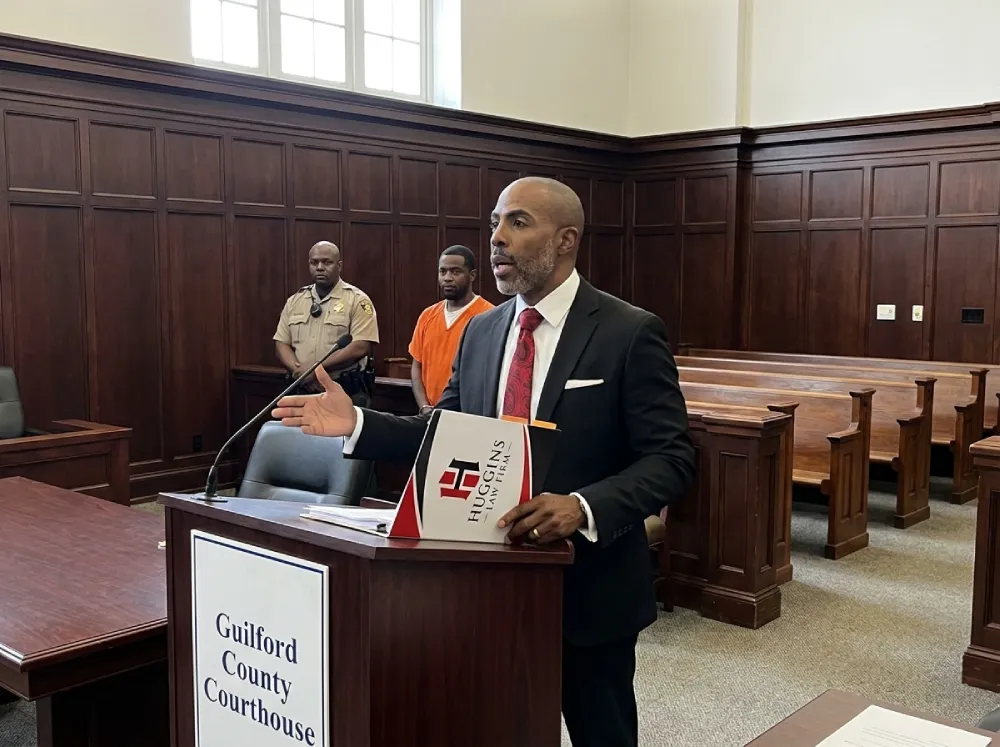
Hi, my name is Attorney Micah Huggins. I am the founder of Huggins Law Firm, P.C.. We have been helping families in the Triad for over a decade. We are highly rated, we have won multiple awards, and we proudly represent the accused in Greensboro, Graham, Burlington, Asheboro, High Point, Kernersville, and Winston-Salem.
If you are reading this, you are probably scared and confused about the jail system. I want to help you understand it.
Our firm’s motto is Justice with Integrity. Representation with Heart. At Huggins Law Firm, we believe that great representation goes beyond knowing the law — it’s about standing up for people when the stakes are high, when the odds are heavy, and when the system feels overwhelming.
Founded by Attorney Micah E. Huggins, the firm was built on a simple conviction: every client deserves clarity, compassion, and a champion in their corner. Whether it’s a criminal defense case, a Family Law matter, Estate Planning, or Personal Injury, we bring the same level of preparation, precision, and purpose to every case we handle.
We don’t just file motions or show up in court. We fight with strategy, we counsel with empathy, and we work to restore what’s been lost — dignity, stability, or peace of mind.
Today, I am going to explain exactly how the bail system works in Guilford County, North Carolina, and how you can fight for a bond reduction.
What Happens Right After an Arrest in Guilford County?
To understand how to get someone out, you have to know where they are and what happens behind closed doors.
If someone is arrested in Greensboro or High Point, they are taken to one of the two local detention centers run by the Guilford County Sheriff’s Office.
Here is a statistic that most people do not know: Every single year, roughly 19,000 people are booked into these two jails. On any given day, there is an average daily population of over 800 inmates across both locations. The Greensboro Jail Central facility alone holds nearly 700 people on an average day, and the High Point Detention Center holds around 270.
Most of the people sitting in those jail cells have not been convicted of a crime. They are “pretrial detainees.” That means they are legally innocent, but they are stuck in jail simply because they cannot afford to buy their freedom.
When the police arrest your loved one, they take them to the magistrate’s office inside the jail. The magistrate is a court official who works for the North Carolina Court System. The magistrate’s job is to look at the charges and set the very first rules for release. This is where the bail is set.
How Does a Magistrate Set Bail in Greensboro and High Point?
The magistrate does not just guess a number. They use a rulebook. In our area, this rulebook is called the Guilford County Pretrial Release Policies, or “Bond Guidelines.”
When deciding how to let someone out of jail, the magistrate has four main choices:
1. Written Promise to Appear (ROR)
This is the best-case scenario. ROR stands for “Release on Recognizance.” It means the magistrate looks at the person, sees they are not a danger, and simply makes them sign a piece of paper promising to come to court. It costs zero dollars. This is mostly used for minor traffic tickets or low-level misdemeanors.
2. Unsecured Bond
This means a dollar amount is set, let’s say $2,000. But, you do not have to pay that money upfront to get out. You only have to pay that $2,000 if you skip your court date.
3. Secured Bond (Cash Bail)
This is what most people mean when they say “bail.” A secured bond means the magistrate sets a number, like $10,000, and that money must be paid before the jail doors open. You can pay the full amount in cash to the jail, or you can pay a bail bondsman a fee (usually around 10% to 15%) to put up the money for you.
4. Custody of Pretrial Services
Guilford County has a special department called Court Services. Sometimes, instead of making you pay a huge cash bond, the judge will let you out if you agree to be monitored by Court Services. This might mean checking in with a case manager every week, taking random drug tests, or wearing an electronic ankle monitor.
What Are the Guilford County Bond Guidelines?
How does the magistrate decide if the bond should be $500 or $50,000? They look at specific facts about the person’s life and the crime they are accused of.
Here are the main things the court looks at:
- The Type of Crime: A drug trafficking charge or an armed robbery will carry a much higher bond than a shoplifting charge.
- Ties to the Community: Do they live in Greensboro? Do they have a steady job in High Point? Does their family live in Winston-Salem? People with strong local roots are less likely to run away, so their bonds are usually lower.
- Past Criminal Record: If a person has a long history of breaking the law, the bond will go up.
- History of Missing Court: If the person has “Failures to Appear” (FTA) on their record from old cases, the magistrate will set a very high cash bond because they do not trust the person to come back.
- Danger to the Public: If the crime was violent, the court wants to protect the community.
Why is My Loved One’s Bond So High?
Sometimes, families call us crying because a bond is set at $100,000 or more, and they have no way to pay it. There are a few reasons why a bond might be set incredibly high or why a person might not be allowed out at all.
The 48-Hour Domestic Hold
If the charge is related to domestic violence, North Carolina law has a strict rule. A regular magistrate cannot set a bond right away. The person must be held in jail without bond for up to 48 hours until a real District Court judge can see them. This is called a “domestic hold.” The goal is to let tempers cool down.
Probation Violations
If you are already on probation and you get arrested for a new crime, the magistrate will almost always set a very high secured bond. The system sees this as breaking a promise you already made to a judge.
Out of State Warrants
If someone from Virginia or South Carolina comes to Greensboro and gets arrested for a serious crime, the magistrate assumes they will just run back home. Because they are a “flight risk,” their bond will be painfully high.
How Can a Criminal Defense Lawyer Get a Bond Reduction?
This is where having an experienced champion in your corner changes everything.
When the magistrate sets the first bond, that number is not written in stone. It is just the starting point. At Huggins Law Firm, one of the very first things we do for a new client in jail is file a Bond Motion (also called a Motion for Bond Reduction).
We do not just walk into the Guilford County Courthouse and beg. We fight with strategy. Here is how we do it:
Step 1: We Investigate the Facts
We talk to your family. We find out where the accused works, where they go to church, and who depends on them. We gather proof that they are a good person who is deeply tied to the Burlington or Asheboro community.
Step 2: We Challenge the Police Story
Often, the police report makes the person sound like a monster. We look for holes in the story. If the evidence against our client is weak, we tell the judge. If the prosecutor has a weak case, the judge is more likely to lower the bond.
Step 3: We Offer Alternatives
Judges want to feel safe. They want to know the person will show up for court and stay out of trouble. We often suggest alternatives to cash. We might ask the judge to drop the bond from $50,000 down to $10,000, but add electronic house arrest. We might suggest that the person live with a strict family member. We give the judge a reason to say “yes.”
Step 4: We Argue in Court
A bond hearing is a mini-trial. We stand up in front of the judge and the District Attorney. We use our legal skills and our passion to argue why keeping this person in a metal cage is wrong. We counsel with empathy, and we make the court see your loved one as a human being, not just an inmate number.
Does Paying a Bail Bondsman Mean the Case is Over?
No. This is a huge mistake people make.
If you pay a bail bondsman $1,000 to get your son out of jail, you are only paying for the jail door to open. You have not hired a lawyer. You have not beaten the charges. The criminal case is just beginning.
If your loved one gets out on bond, they still have to go to every single court date. If they miss court, the judge will issue an Order for Arrest. The bondsman will send bounty hunters to find them, and they will go right back to jail.
Once you get them out, your next call needs to be to a law firm that handles criminal cases. You need someone to actually fight the charges so they don’t end up in prison.
Why Choose Huggins Law Firm for Your Bond Motion?
When the stakes are high, you need someone who knows the local system. We know the judges in Guilford, Alamance, Randolph, and Forsyth counties. We know what arguments work, and we know what arguments fail.
We represent people facing everything from simple DWI charges to complex felonies. We treat every single family with the respect and clarity they deserve. We know this is the worst week of your life, and we are here to help you navigate it.
10 of the Most Common Questions Asked About Bail and Bonds in North Carolina
When a family member is locked up, we get hundreds of questions. Here are the top ten questions people ask us about the bail system in North Carolina, answered simply.
1. What is the difference between bail and bond in NC?
People use the words like they mean the same thing, but they are slightly different. “Bail” is the actual money you pay to the court to get out. A “Bond” is a promise. When you use a bail bondsman, they write a “surety bond,” which is a promise to the court that they will pay the full amount if you run away.
2. How long does a magistrate take to set a bond in Greensboro?
Usually, it happens very fast. After the police finish booking you, taking your fingerprints, and taking your mugshot, you will see a magistrate within a few hours.
3. Can I pay the jail directly instead of using a bondsman?
Yes. If the bond is $5,000, you can bring $5,000 in cash directly to the clerk at the jail. This is called paying the full cash bond.
4. Do I get my bail money back if my case is dismissed?
If you paid the full cash amount directly to the jail, yes. Once the case is totally closed (whether you win or lose), you get that money back from the court. However, if you paid a 10% fee to a bail bondsman, you NEVER get that money back. That is their fee for doing business.
5. What happens if I miss court while out on bond?
The judge will be very angry. They will issue an “Order for Arrest” (OFA). Your bond will be doubled or tripled. If you used a bondsman, they will start looking for you because they do not want to lose their money.
6. Can a judge revoke my bond?
Yes. If you get out on bond and then get arrested for a brand new crime, the judge can revoke your old bond. That means you stay in jail until your trial, no matter how much money you have.
7. Will my bond be lower if I turn myself in?
Almost always, yes. If you find out you have a warrant and you hire a lawyer to walk you into the police station, the magistrate sees that you are cooperating. This proves you are not a flight risk, which usually results in a much lower bond.
8. What is a 48-hour domestic hold?
If you are charged with hurting a family member or partner, you cannot bond out immediately. By law, you must sit in jail until a judge sees you, which can take up to 48 hours. After that time passes, a bond will finally be set.
9. Can I leave the state of North Carolina while out on bond?
It depends on the rules the judge gave you. Sometimes, a condition of your release is that you cannot leave Guilford County. Other times, there are no travel limits. You must ask your lawyer to check your specific bond paperwork before you travel.
10. How fast can a lawyer file a bond motion in Guilford County?
Once you hire us, we move fast. We can usually draft the motion and get it filed within a day or two. However, the court has to put it on the calendar, which means it might take a few days to actually stand in front of the judge for the hearing.
Do Not Let the System Overwhelm You
Having a loved one in the Guilford County jail is a terrifying experience. The system is cold, fast, and unforgiving. You need a champion.
At Huggins Law Firm, P.C., we stand ready to fight for your family. We will listen to your story, explain your options clearly, and work tirelessly to bring your loved one home.
If you need help with a bond reduction, a criminal charge, or a family law issue in Greensboro, High Point, Graham, Burlington, Asheboro, Kernersville, or Winston-Salem, reach out to us today.
Visit our home page to learn more about how we can help you restore what’s been lost. Justice with Integrity. Representation with Heart. We are ready when you are.