
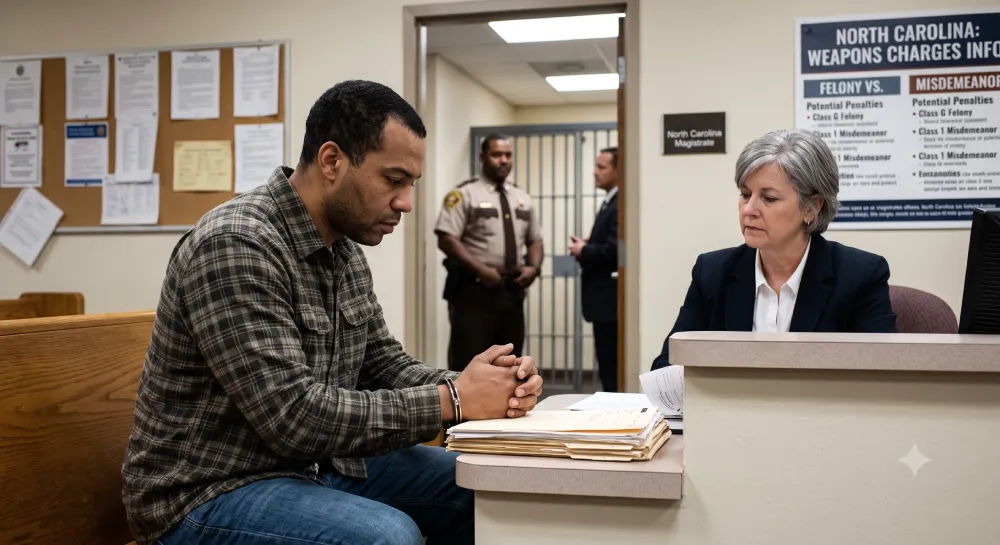
Weapons Charges in North Carolina: Felony vs. Misdemeanor — What You’re Really Facing
The charge on that paper in your hand means something very specific. Here’s exactly what it means — and where your defense begins.
Possession of a firearm by a felon is the single most commonly sentenced felony in all of North Carolina. It’s not the most violent. It’s not the most serious. But it gets more sentences than any other felony in this state — and it routinely gets people federal time on top of state time. If that’s what you’re facing, get an attorney immediately. Call Huggins Law Firm today.
Here’s something that people don’t fully appreciate when they first look at a weapons charge in North Carolina: the difference between misdemeanor and felony in these cases is sometimes a single fact. One prior felony conviction. Whether the gun was concealed or open. Whether you were on school property. Whether there was a protective order in effect. That single fact can be the difference between a fine and a decade in prison.
Attorney Micah Huggins has spent over a decade in Guilford County courtrooms handling exactly these cases — from concealed carry violations to felony possession by a convicted felon, and from assault with a deadly weapon to federal firearms charges.
Key Takeaways — NC Weapons Charges
- Possession of a firearm by a felon is the single most commonly sentenced felony in North Carolina — more than any other crime (NC Sentencing Commission, FY 2024).
- NC is the 17th state in the nation for highest gun crime rates.
- There are approximately 814,000 North Carolina residents with valid concealed handgun permits — but even permit holders can be charged if they carry in a prohibited location.
- A first-offense concealed carry violation is a Class 2 misdemeanor (up to 60 days). A second offense jumps to a Class H felony (5-20 months).
- Possession of a firearm by a felon under NC law is a Class G felony — 12 to 26 months — and can also trigger federal charges under 18 U.S.C. section 922(g), carrying up to 10 years federal time.
- The TSA found 250 firearms in carry-on luggage at North Carolina airports in 2024 — 240 of them loaded.
- Assault with a deadly weapon can range from a Class A1 misdemeanor to a Class C felony depending on intent and injury.
- North Carolina’s Habitual Felon Law can turn a weapons conviction into a dramatically enhanced sentence.
- Attorney Huggins represents clients facing weapons charges across Greensboro, High Point, and the Triad.
NC Weapons Charge Reference Table
| Charge | NC Statute | Class | Typical Sentence Range |
|---|---|---|---|
| Carrying concealed weapon — 1st offense | section 14-415.21 | Class 2 Misdemeanor | Up to 60 days / fine |
| Carrying concealed weapon — 2nd offense | section 14-415.21 | Class H Felony | 5-20 months |
| Weapon on school property | section 14-269.2 | Class I Felony | 4-10 months |
| Discharge firearm on school grounds | section 14-269.2 | Class F Felony | 13-33 months |
| Firearm under DVPO (50B) | section 50B-3.1 | Class H Felony | 5-20 months + federal exposure |
| Possession of firearm by felon (state) | section 14-415.1 | Class G Felony | 12-26 months (up to 39 with priors) |
| Felon in possession (federal) | 18 U.S.C. section 922(g) | Federal Felony | Up to 10 years federal + mandatory minimums |
| Assault with deadly weapon (no injury, no intent) | section 14-33 | Class A1 Misdemeanor | Up to 150 days |
| Assault with deadly weapon inflicting serious injury | section 14-32 | Class E Felony | 15-63 months |
| AWDWISI with intent to kill | section 14-32 | Class C or D Felony | 38-182+ months |
| Robbery with dangerous weapon | section 14-87 | Class D Felony | 38-160 months |
| Discharge firearm at occupied property | section 14-34.1 | Class E or F Felony | 13-63 months |
| Possession of stolen firearm | section 14-71.1 | Class H Felony | 5-20 months |
Why Is Possession of a Firearm by a Felon So Heavily Prosecuted?
Under N.C.G.S. section 14-415.1, the North Carolina Felony Firearms Act, it is a Class G felony for any convicted felon to own, possess, or have in their custody any firearm. The prohibition is permanent — regardless of how long ago the conviction was.
Key things most people don’t know: The weapon doesn’t have to be on your person — “possession” includes constructive possession (the gun in your car, in a closet, under your bed). It counts as a second felony under NC sentencing. Federal charges can run simultaneously under 18 U.S.C. section 922(g), carrying up to 10 years in federal prison — and federal prison means serving at least 85% with no parole.
The Habitual Felon multiplier: If you have three prior felony convictions, North Carolina’s Habitual Felon Law elevates the offense class by four levels. A Class G felony becomes a Class C felony — meaning 44-182 months instead of 12-26 months. This is why the charge profile of each defendant matters so enormously.
Defense Strategies for Felon in Possession Charges
- Fourth Amendment suppression: If the gun was found during an illegal search, a successful suppression motion removes the gun from evidence. No gun, no case.
- Constructive possession challenge: In shared spaces, the state must prove the defendant specifically had knowledge of and control over the weapon.
- Knowledge challenge: In cases where a weapon was in someone’s property without their knowledge.
- Challenging the prior conviction: If the prior felony was expunged or involved a state that restored firearm rights.
- Negotiating state vs. federal prosecution: An attorney who can engage early with both the DA and the U.S. Attorney’s office can affect which venue prosecutes.
How Does Assault With a Deadly Weapon Work in NC?
AWDW in North Carolina is a ladder of charges: No serious injury, no intent to kill = Class A1 misdemeanor (up to 150 days). Serious injury = Class E felony (15-63 months). Intent to kill without serious injury = Class E felony. Intent to kill with serious injury (AWDWIKISI) = Class C felony (44-182+ months).
What counts as a “deadly weapon”: The definition is broader than most people expect — a firearm, knife, baseball bat, a car used to strike someone, a bottle, and other everyday objects when used in a way capable of causing death or serious injury.
10 Questions About Weapons Charges in NC
1. What happens if a felon is caught with a gun in NC? Class G felony (12-26 months state), plus potential federal charges (up to 10 years). Both state and federal prosecution have been actively pursued in Guilford County.
2. Can I carry a concealed gun without a permit? No. First offense is a Class 2 misdemeanor; second offense becomes a Class H felony.
3. What is AWDW and what class felony is it? A ladder of charges from Class A1 misdemeanor to Class C felony, depending on injury and intent.
4. Can a felon ever get their gun rights back in NC? In limited circumstances — under N.C.G.S. section 14-415.4, individuals with a single nonviolent felony may petition for restoration.
5. What is the Habitual Felon Law? Three prior felony convictions elevate any new felony by four class levels — potentially turning months into decades.
6. What are prohibited locations for firearms in Guilford County? Schools, courthouses, government buildings, law enforcement offices, financial institutions, establishments serving alcohol, places charging admission, and polling places.
7. Can I be charged if the gun wasn’t on my person? Yes — through constructive possession. If the gun was in your car, home, or any space where you had access and control.
8. What’s the difference between state and federal weapons charges? Federal sentences are governed by mandatory guidelines, run at 85% with no parole, and prosecutors have significant resources. The Armed Career Criminal Act can impose 15-year mandatory minimums.
9. Does a weapons charge affect child custody? It can — particularly if the charge involves violence or is a recent felony. Huggins Law Firm handles both criminal defense and family law.
10. What should I do if arrested for a weapons charge? Exercise your right to remain silent immediately. Do not explain the situation. Invoke your right to counsel. Call Huggins Law Firm as soon as you can.
This page is for general informational purposes only and does not constitute legal advice. Contact Attorney Micah Huggins for advice specific to your situation. Serving Greensboro, High Point, Graham, Burlington, Asheboro, Kernersville, and Winston-Salem.