
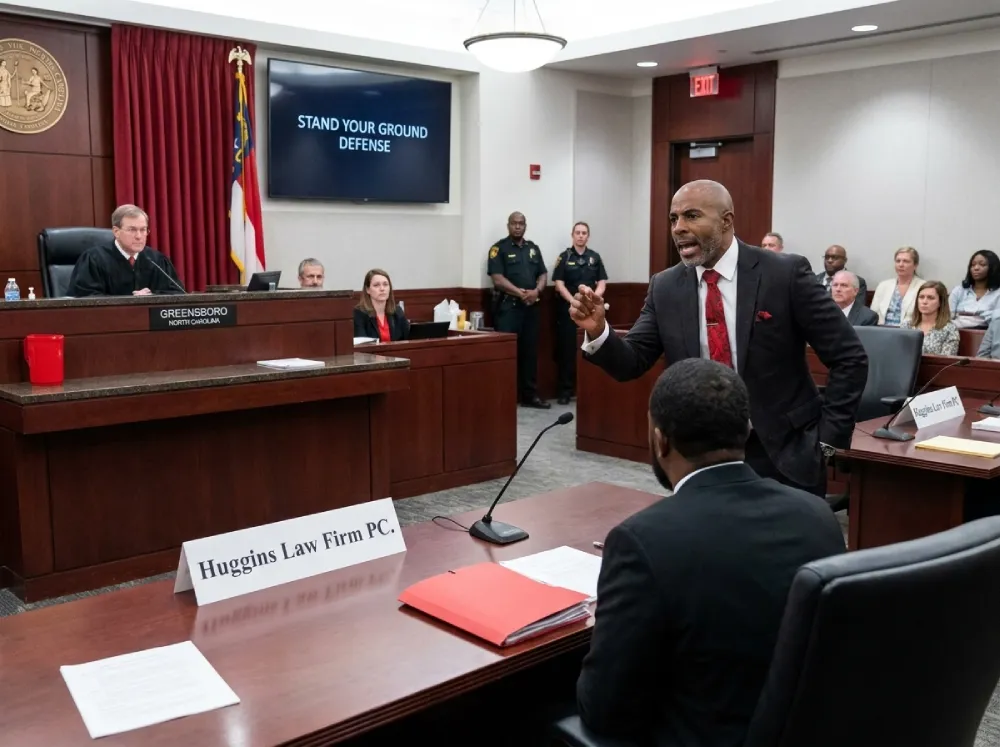
Key Takeaways
- You Can Protect Yourself: North Carolina has very strong self-defense laws. If you are in real danger of being hurt or killed, you have the right to fight back to protect your life.
- Stand Your Ground: If you are in a place you are legally allowed to be, you do not have to run away before protecting yourself. You can stand your ground.
- The Castle Doctrine: Your home, your car, and your workplace are your “castles.” The law gives you extra protection if an intruder forcefully breaks in.
- Proportional Force: You can only use the amount of force needed to stop the threat. You cannot shoot someone just for yelling at you or pushing you.
- We Are Your Champion: Assault and homicide charges are terrifying. At Huggins Law Firm, we know how to investigate the facts and prove you were just protecting yourself.
Hello, my name is Attorney Micah Huggins. I am the founder of Huggins Law Firm, P.C.. We have been helping folks in our community for over a decade. We are highly rated, and we have won multiple awards. But awards are not what matter to us. What matters is keeping you safe, keeping you out of prison, and keeping your family together.
Our firm was built on a very simple slogan: Justice with Integrity. Representation with Heart. At Huggins Law Firm, we believe that great representation goes beyond knowing the law — it’s about standing up for people when the stakes are high, when the odds are heavy, and when the system feels overwhelming.
Founded by Attorney Micah E. Huggins, the firm was built on a simple conviction: every client deserves clarity, compassion, and a champion in their corner. Whether it’s a criminal defense case, a Family Law matter, Estate Planning, or a Personal Injury dispute, we bring the same level of preparation, precision, and purpose to every case we handle.
We don’t just file motions or show up in court. We fight with strategy, we counsel with empathy, and we work to restore what’s been lost — dignity, stability, or peace of mind.
Today, we are talking about a very serious and scary topic. What happens when you have to use physical force to protect yourself or your family? When is force justified in North Carolina? Let’s break down the law so it is very easy to understand.
What Are the Basics of Self-Defense in North Carolina?
If someone attacks you, you do not have to just stand there and take it. The law says you have a fundamental right to defend yourself. But the law also has very strict rules.
There are two types of force: standard force and deadly force.
To use standard force (like pushing someone away, grabbing their arms, or punching them), you must honestly believe that force is needed right then and there to stop someone from hurting you.
To use deadly force (like using a gun, a knife, or a heavy weapon), the rules are much stricter. You must reasonably believe that deadly force is the absolutely only way to stop someone from killing you or causing you “great bodily harm.” Great bodily harm means an injury that breaks your bones, damages your organs, or leaves you permanently scarred.
If you use too much force, the police will step in. You could be facing major assault charges or even homicide.
What is the “Stand Your Ground” Law in North Carolina?
Almost everyone has heard the phrase “Stand Your Ground” on the news. But what does it really mean in real life?
In the old days, the law said you had a “duty to retreat.” That meant if someone attacked you on the street, you had to try to run away first. You had to look for an escape route. You could only fight back if you were trapped in a corner.
North Carolina changed this rule. We now have a true “Stand Your Ground” law. This means you do not have a duty to run away. If you are in a place where you have a lawful right to be (like a public park in Winston-Salem, a sidewalk in Kernersville, or a grocery store in Asheboro), you do not have to turn your back and run. You can stand your ground and fight back to protect yourself.
What is the “Castle Doctrine” in NC?
Your home is your safest place. The law agrees with you. This rule is called the “Castle Doctrine,” because your home is your castle.
In North Carolina, the Castle Doctrine applies to three specific places:
- Your home (where you sleep and live)
- Your motor vehicle (your car, truck, or van)
- Your workplace (your business or office)
If someone tries to forcefully and illegally break into your home, your car, or your workplace while you are inside, the law automatically assumes they are there to kill you or hurt you badly.
Because the law assumes this, you are allowed to use deadly force to stop them. You do not have to wait for them to pull out a weapon. You do not have to ask them what they want. If they are breaking into your castle, you can protect it.
When Does Self-Defense Turn into an Assault or Homicide Crime?
The line between justified self-defense and a serious crime can be very thin. It usually comes down to one word: Proportionality. Let’s look at the statistics in our local area to see why this matters. Violence is a real problem. The Guilford County Violence Profile recently showed that over 2,500 violent crimes happen here every single year. Over 67% of those crimes are aggravated assaults.
Here is a shocking fact that very few people know: In Guilford County, 35% of all homicides start as a simple argument or a conflict. This is exactly where things go wrong. Imagine two people get into a yelling match outside a restaurant in High Point. One person gets mad and pushes the other person. The second person pulls out a gun and shoots.
Is that self-defense? Almost always, the answer is no. That is called using “disproportionate force.” You cannot use deadly force to stop a simple push. The force you use must match the threat. If someone is just pushing you, you can push them back. But if you escalate the fight and pull out a deadly weapon, the police will arrest you.
Also, if you are the one who starts the fight, you are the “aggressor.” You lose your right to claim self-defense. You cannot pick a fight with someone, start throwing punches, and then claim self-defense when they start winning the fight.
What Do the Violence Statistics Look Like in Greensboro and Guilford County?
To understand why the police and prosecutors are so strict, we need to look at the numbers.
In recent years, the North Carolina State Bureau of Investigation (SBI) reported that the overall crime rate across the state has been slowly dropping. But the numbers are still very serious in the Triad.
According to local data, the Greensboro Police Department responds to over 1,600 aggravated assaults and around 40 homicides in a single year. Furthermore, data from the North Carolina Department of Public Safety (NC DPS) shows that an overwhelming 81% of homicides in Guilford County involve a firearm.
Because gun violence is so common here, the police and the prosecutors in the Guilford County Court System are extremely tough. When they respond to a 911 call and see a fight that ends with someone bleeding, they do not hold a trial on the street. They usually arrest everyone involved. They let the judge sort it out later.
This means that innocent, hardworking people who were just trying to protect themselves often get thrown in the back of a police car and charged with serious crimes.
Can You Use Force to Protect Someone Else?
Yes. North Carolina law allows you to use force to protect a family member, a friend, or even a total stranger who is in danger. This is called the “defense of others.”
The rules are exactly the same as protecting yourself. If you see someone being attacked, you can use the same amount of force that the victim would be legally allowed to use.
But you must be very careful. If you walk out of a store in Burlington and see two people fighting, and you jump in to help the person losing, you are taking a huge risk. What if the person losing the fight was actually the bad guy who started it? If you jump in and hurt the innocent person, you could go to jail.
What Should You Do Immediately After Using Self-Defense?
If you ever have to use force to protect yourself, your heart will be pounding. You will be full of adrenaline. But you must be smart to protect your freedom.
- Call 911: Be the first person to call the police. Tell the dispatcher, “I was attacked, I had to defend myself, and please send an ambulance.”
- Put Your Weapon Down: When the police arrive, they do not know who the good guy is. Put your hands up. Do not hold anything in your hands.
- Say You Want Your Lawyer: The police will try to ask you a hundred questions. They might seem friendly. Do not tell them a long story. Simply say, “I was attacked. I will cooperate, but I will not answer any questions without my lawyer present.”
- Call Micah Huggins: The moment you are allowed to make a phone call, call Huggins Law Firm.
How Can Attorney Micah Huggins Protect Your Freedom?
If you had to hurt someone to protect yourself, you might be terrified. The police are investigating you. The prosecutor wants to put you in prison. The system feels like a giant machine trying to crush you.
This is why you need a champion. At Huggins Law Firm, we handle serious criminal cases every single day in Greensboro, Graham, Burlington, Asheboro, High Point, Kernersville, and Winston-Salem.
We do not just look at the police report. The police report only tells the officer’s side of the story. We dig deeper.
- We send investigators to look for hidden security cameras.
- We track down witnesses who saw the other person attack you first.
- We dive into the medical records.
Because we also handle complex Personal Injury cases, we know exactly how to read medical data to prove how an injury truly happened. If your self-defense case involves a spouse or family member, our Family Law team understands how to navigate the complicated domestic violence rules. We protect your whole life.
We will stand up in court and tell the judge and the jury the absolute truth: you are not a criminal. You were just trying to survive.
10 of the Most Common Questions Asked About Self-Defense in North Carolina
People have a lot of confusing questions about self-defense. Here are the 10 most common questions we hear at our firm, and the clear answers you need.
1. Do I have to wait for the attacker to hit me first before I fight back?
No. You do not have to wait to be injured. If someone is charging at you with a weapon, or swinging a baseball bat at your head, you can defend yourself before the blow lands. The danger just has to be “imminent” (happening right this second).
2. Can I shoot someone for stealing my property or my car?
No. In North Carolina, you cannot use deadly force just to protect “stuff.” If someone is running away down the street with your television or your purse, you cannot shoot them in the back. Deadly force is only for protecting human life, not property.
3. What if I was carrying a gun without a permit when I was attacked?
If you are illegally carrying a concealed weapon, it makes your case much harder. The prosecutor will say you were already breaking the law. However, even if you had no permit, you still have the basic human right to self-defense. You just need an expert lawyer to fight the weapons charge.
4. Does the “Stand Your Ground” law protect me if I am trespassing?
No. If you are somewhere you are not legally supposed to be (like trespassing in someone else’s yard), the Stand Your Ground law does not protect you. If you are trespassing, the law says you have a strict duty to try to run away before you use force.
5. Does the Castle Doctrine protect me if I shoot a police officer breaking in?
No. The Castle Doctrine does not apply to law enforcement officers who are doing their official jobs. If the police are coming into your house with a legal search warrant, you cannot use force against them.
6. What if the attacker is totally unarmed, but they are much bigger than me?
This is a great question. You can only use deadly force to prevent death or great bodily harm. If a 300-pound man is violently attacking a 100-pound woman with his bare hands, the court will often agree that his massive size and fists were a deadly weapon.
7. Can words alone justify using physical self-defense?
No. If someone is just calling you bad names, insulting your family, or screaming at you, you cannot punch them. Words, no matter how mean they are, do not give you the right to use physical force.
8. What happens if I accidentally hurt an innocent bystander while defending myself?
If you are legally defending yourself and you accidentally hurt a bystander, the criminal law usually protects you from being charged with a crime. However, the injured bystander might still try to sue you for money in civil court.
9. Will I still be arrested if it was clearly self-defense?
Yes, it happens all the time. The police on the street do not hold trials. If there is a dead or badly injured body on the ground, the police will often make an arrest to be safe, and they will let the lawyers and the judge figure out the truth later.
10. How much does it cost to hire a lawyer for an assault or homicide case?
Every case is different. A simple bar fight costs much less than a major homicide trial. At Huggins Law Firm, we believe in complete clarity. We will sit down with you, look at the facts of your case, and tell you exactly what it will cost before you hire us.
Do Not Wait. Let Us Stand Up For You.
If you have been charged with a crime after protecting yourself in Greensboro, Winston-Salem, Graham, Burlington, Asheboro, High Point, or Kernersville, do not wait. Every second counts. The state is already building a case against you.
Visit our home page today to schedule a meeting. You can also explore the NC Court System self-help resources or the North Carolina General Assembly website to read the statutes for yourself.
Let Huggins Law Firm be the champion in your corner. Let us fight to restore your peace of mind.