
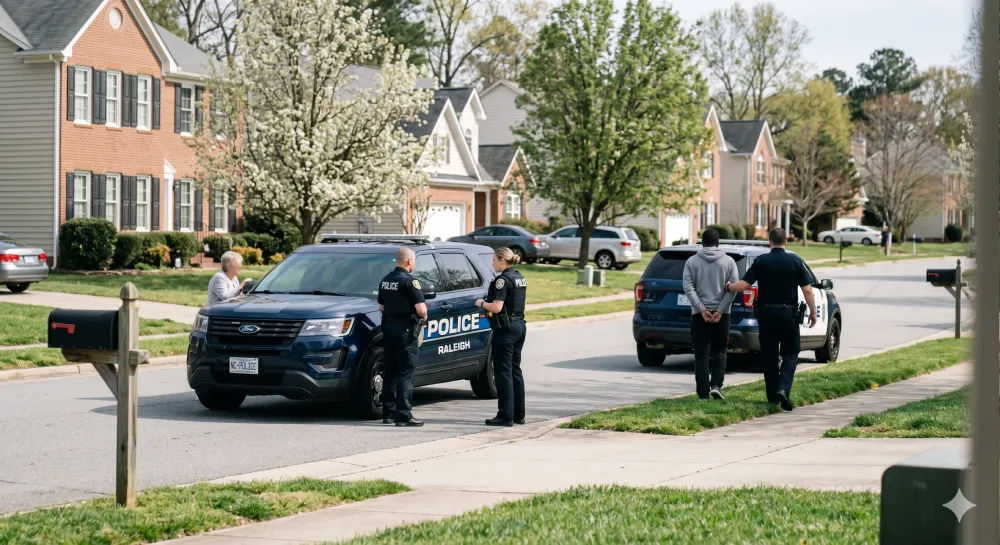
Here’s the thing nobody tells you when the handcuffs go on.
You have a very small window of time — sometimes just hours — where the decisions you make, the things you say, and the steps you either take or don’t take will shape everything that comes next. Your living situation. Your relationship with your kids. Your job. Your freedom. And most people, in that window, are completely blindsided because nobody ever sat down and explained how this actually works in North Carolina.
I’ve been doing this for over a decade. I’ve sat across from hundreds of people — good people, people who made a terrible mistake in a terrible moment, people who were falsely accused, people who were genuinely confused about what they even did wrong — and the ones who came to me early almost always had better outcomes than the ones who waited. Not because I’m magic. Because information is power, and timing is everything in a domestic violence case in North Carolina.
This guide is specifically for people who have been arrested for a domestic violence offense in Greensboro, High Point, and the surrounding Triad area. We’re going to walk through everything that happens after that arrest — the 48-hour hold, the protective order process, the no-contact orders, the court system you’re now dealing with — and what you can actually do to protect yourself at every stage.
⚡ Key Takeaways — Read These Before the Rest
- North Carolina has a mandatory 48-hour hold for most domestic violence arrests — you cannot bond out immediately, and this is intentional under state law.
- A Domestic Violence Protective Order (DVPO) can be issued without you present — often before you even leave jail — and violating it is a separate criminal charge.
- No-contact orders can remove you from your own home, even if your name is on the lease or mortgage.
- Anything you say to police, in jail calls, or in text messages will be used against you. This is not a figure of speech.
- The alleged victim cannot “drop the charges” in North Carolina — the State prosecutes, not the victim.
- Guilford County courts process thousands of DV cases annually — you are not dealing with an inexperienced system that will overlook details.
- A conviction carries consequences far beyond jail time — including permanent loss of firearm rights under federal law.
- The single most important thing you can do right now is call an experienced criminal defense attorney before you say anything else to anyone.
How Serious Is Domestic Violence in Greensboro, High Point, and Guilford County — and What Does the Data Actually Tell Us?
Let’s start with the numbers, because understanding the scale of what you’re walking into matters.
12,000+
Domestic violence-related calls handled by Greensboro Police annually (GPD Annual Report)
#3
Guilford County ranks among NC’s top 3 counties for total DV-related offenses reported (NC DPS)
~40%
Of all assault charges in Guilford County involve a domestic relationship (NC AOC court data)
48 hrs
Mandatory minimum hold under NC Gen. Stat. § 15A-534.1 before DV defendants can bond out
According to the North Carolina Department of Public Safety, Guilford County — which covers both Greensboro and High Point — consistently ranks among the top five counties in the state for domestic violence incidents. Greensboro alone, with a population around 300,000, sees more domestic violence calls than most cities its size in the Southeast.
Here’s something the local data shows that people rarely talk about: according to the North Carolina Administrative Office of the Courts, the Guilford County District Court processes one of the highest volumes of domestic violence cases in the entire state. That means the prosecutors, the judges, and the court staff handling your case do this every single day. They are not new to this. They know the statutes. They know the common defenses. They know when someone doesn’t have adequate legal representation — and it shows in the outcomes.
High Point, which sits in the southwestern corner of Guilford County and has its own police department and court district, mirrors these patterns. The High Point Police Department’s annual reports consistently show that domestic disturbance calls are among the most common calls for service in the city — and a significant percentage of those calls result in at least one arrest.
A stat worth knowing: The NC Department of Health and Human Services reports that North Carolina has one of the higher rates of intimate partner violence in the Southeast, with roughly 35% of women and 28% of men in the state reporting some form of intimate partner violence in their lifetime. These numbers explain why NC courts, law enforcement, and the legislature have built an aggressive statutory framework around domestic violence cases — one that moves fast and hits hard, whether or not the accused is actually guilty.
And here’s the most sobering local fact: according to the NC Coalition Against Domestic Violence, North Carolina has ranked in the top 10 states nationally for domestic violence homicide rates in multiple recent years. That context is why the courts treat every domestic violence arrest with a degree of urgency that can feel overwhelming if you’re on the receiving end of it.
What Happens Immediately After a Domestic Violence Arrest in Greensboro or High Point — The First 48 Hours
Most people have no idea what’s coming the moment the patrol car door closes. Let’s fix that.
1.You Will Be Taken to the Guilford County Detention Center or High Point Jail
Depending on where the arrest occurred, you’ll be transported to either the Guilford County Detention Center in downtown Greensboro or the High Point city jail. You will be processed — photographed, fingerprinted, and booked on whatever charges the arresting officer has written. This is not the time to explain your side of the story. It is the time to stay calm and say as little as possible beyond identifying yourself.
2.The Mandatory 48-Hour Hold Begins — You Cannot Bond Out Right Away
This is the part that shocks almost everyone. Under North Carolina General Statute § 15A-534.1, a person arrested for a domestic violence offense must be held for a minimum of 48 hours before they can be released on bond — regardless of whether they have money, a bondsman ready, or a squeaky-clean record. The clock starts at the time of arrest. You cannot buy your way out in the first 48 hours. This is a hard rule, and it applies in Guilford County the same as everywhere else in North Carolina.
3.A Magistrate Will Set Conditions of Release — This Is Critical
During the 48-hour hold, a magistrate will review your case and set conditions for your potential release. These conditions almost always include a no-contact provision with the alleged victim. They may also include a requirement that you not return to the shared residence — even if your name is on the lease. This happens without a full hearing, often within hours of your arrest, and you will likely not have an attorney present for this stage. This is one reason why having an attorney engaged early — even during the hold period — can make a difference in what conditions are ultimately set.
4.A Domestic Violence Protective Order (DVPO) May Be Issued Before You Leave Jail
Under NC General Statute Chapter 50B, the alleged victim can petition the court for an Emergency Domestic Violence Protective Order — sometimes called an ex parte DVPO — without you being present. A judge can grant this order based solely on the alleged victim’s sworn statement. It can order you to stay away from the home, the alleged victim’s workplace, and even your children’s school. You find out about it when you’re served — sometimes right as you’re being released from jail.
5Your First Appearance in Guilford County District Court
After the 48-hour hold, you’ll be brought before a District Court judge — or you’ll have your first appearance scheduled — where bond conditions will be reviewed and formal charges will be addressed. In Guilford County, domestic violence cases move through the court system at a steady pace. The Greensboro courthouse and High Point courthouse both handle high volumes of these cases weekly. This is your first real opportunity to have legal representation present and working for you.
🚨 Do NOT do this during the 48-hour hold: Do not call the alleged victim from jail. Jail phone calls in Guilford County are recorded — every single one. Prosecutors regularly request and use these recordings. Calling to apologize, to explain, to ask them to “drop it,” or even just to check in is a mistake that can and will be used against you. The no-contact condition that the magistrate set is a legal order. Violating it from a jail phone is not just bad strategy — it’s a new criminal charge on top of everything else.
What Is a Domestic Violence Protective Order (DVPO) in North Carolina — and How Does It Affect Your Life?
The Domestic Violence Protective Order — commonly called a DVPO or a “50B order” after the NC statute that governs it — is one of the most powerful and immediately life-altering legal tools in the North Carolina court system. Most people don’t understand how broad it can be until they’re living under one.
Here’s what a DVPO in Guilford County or the High Point district can actually do:
- Remove you from your home — even if you own it, even if your name is on the mortgage, even if the alleged victim does not pay rent
- Prohibit all contact with the alleged victim — phone, text, email, social media, through third parties, all of it
- Award temporary custody of your children to the other party pending a full hearing
- Prohibit you from possessing firearms — and require you to surrender any weapons you currently own
- Restrict your ability to be near certain locations — schools, workplaces, neighborhoods
- Require you to pay support to the alleged victim while the order is in effect
The initial ex parte order (issued without you present) is typically temporary — valid for up to 10 days. But a hearing will be scheduled, and if the court grants a full DVPO after that hearing, it can remain in effect for up to one year and be renewed annually. Some people in North Carolina have lived under active DVPOs for years.
Ex Parte DVPO (Emergency)
- Issued without your presence
- Based solely on alleged victim’s statement
- Takes effect immediately upon service
- Valid up to 10 days
- Followed by a full hearing
- You have the right to contest it
Full DVPO (After Hearing)
- Issued after both parties have a chance to be heard
- Can last up to one year, renewable
- May include custody, support, and property provisions
- Violation is a Class A1 misdemeanor
- Second violation is a Class H felony
- Federal firearms prohibition attaches automatically
⚠️ The DVPO hearing is not optional and it is not informal. Many people show up to their DVPO hearing without an attorney, assuming it will be a brief conversation. It is a legal proceeding where evidence is presented, witnesses may testify, and a judge makes legal findings that will follow you — in custody proceedings, in criminal cases, in background checks — for a very long time. Having Attorney Micah Huggins at that hearing is not a luxury. It is a strategic necessity.
What’s the Difference Between a No-Contact Order and a Protective Order in NC — and What Happens If You Violate Either One?
This is where people get tripped up more than almost anywhere else in domestic violence cases — and where innocent mistakes turn into additional criminal charges.
In North Carolina, there are two different types of orders that may be in place after a domestic violence arrest, and they come from two different parts of the legal system:
The Criminal No-Contact Order
This is a condition of your release set by the magistrate or judge as part of your bond. It’s a criminal court order. It says you cannot contact the alleged victim while your criminal case is pending. Violating it means you’ve violated the terms of your release — which can result in your bond being revoked and you going back to jail. It can also result in new charges.
The Civil DVPO (50B Order)
This is a separate civil court order obtained through the family/civil division of the court. It is a civil legal matter, not a criminal one. But violating it — even if the alleged victim initiated the contact — creates a criminal offense. This is a distinction that trips people up constantly. If the alleged victim texts you first and you respond, you have still violated the order. If they show up at your door and you let them in, you have still violated the order. The alleged victim cannot “lift” or waive the order informally. Only a judge can modify it.
🚨 This is one of the most dangerous misunderstandings in domestic violence cases: Defendants frequently believe that if the alleged victim reaches out to them first — calls, texts, shows up — then contact is okay. It is not. You are the one bound by the order. The alleged victim’s actions do not release you from your legal obligations. People in Guilford County and High Point have gone back to jail — and picked up new charges — because they assumed the victim’s outreach meant the order was suspended. It doesn’t work that way.
What Are the Most Common Domestic Violence Charges Filed in Guilford County and High Point Courts?
Not all domestic violence cases are the same, and not all charges carry the same weight. Here’s what the data shows about the most common charges in the Greensboro and High Point court systems:
- Assault on a Female (N.C. Gen. Stat. § 14-33(c)(2)): One of the most frequently charged DV offenses in Guilford County. A Class A1 misdemeanor when the alleged victim is a female and the defendant is a male. The “assault” under this statute can be extremely broad — physical contact that causes fear, not necessarily injury.
- Simple Assault (N.C. Gen. Stat. § 14-33): A Class 2 misdemeanor that becomes elevated when it involves household members and repeat offenses.
- Communicating Threats (N.C. Gen. Stat. § 14-277.1): Threatening someone in a domestic relationship — including via text or voicemail — is a Class 1 misdemeanor and one of the most commonly charged alongside physical assault charges.
- Stalking (N.C. Gen. Stat. § 14-277.3A): Increasingly charged in High Point and Greensboro cases involving repeated contact after a separation. A Class A1 misdemeanor for first offense; a Class F felony for second.
- Interfering with Emergency Communication (N.C. Gen. Stat. § 14-286.2): Taking someone’s phone, blocking a 911 call — this charge appears in a surprising number of DV arrests and is a Class A1 misdemeanor.
- Felony Assault Inflicting Serious Injury: When injuries require medical attention, charges can escalate quickly to felony level — carrying potential prison time and all the long-term consequences of a felony conviction.
Guilford County court data note: According to the NC Administrative Office of the Courts, assault on a female and communicating threats are consistently among the top five most frequently charged misdemeanors in Guilford County District Court. These are not charges that prosecutors routinely dismiss or plea down without competent advocacy on the defendant’s side. The Guilford County District Attorney’s office has dedicated domestic violence prosecutors — people whose entire job is to build and prosecute these cases.
What Should You Actually Do to Protect Yourself After a Domestic Violence Arrest in Greensboro or High Point?
Beyond the immediate 48-hour period, here’s how you protect yourself through the process that follows:
1Get an Attorney Before Your First Court Appearance
I cannot say this clearly enough. The Guilford County District Court moves quickly on domestic violence cases. By the time you have your first formal appearance, decisions will have already been made — about your bond conditions, about a protective order, about how the case is being framed. An attorney working for you before that appearance can influence all of those things. Call Huggins Law Firm the moment you or a family member is able to make that call.
2.Preserve Every Piece of Evidence That Supports Your Account
Text messages. Voicemails. Photos. Witnesses who were present. Video footage if any cameras were running. Your attorney will need all of it. Don’t delete anything, don’t send anything new that you wouldn’t want read in court, and don’t post anything about the situation on social media. Prosecutors in Guilford County routinely request social media records in domestic violence cases — and screenshots of what you posted in the days after your arrest have shown up as evidence in court.
3.Comply Fully with Every Condition of Your Release
Even if a condition feels unfair. Even if you think the no-contact order shouldn’t apply. Even if you need to get belongings from the home. Violating any condition of release adds charges and almost certainly revokes your bond. If you need to retrieve personal property from a shared home, your attorney can work with the court or law enforcement to arrange a supervised retrieval. There is a right way to do this that doesn’t land you back in the Guilford County Detention Center.
4.Attend Every Court Date — Without Exception
Missing a court date in Guilford County generates a Failure to Appear charge and an immediate warrant for your arrest. This is true whether you forgot, whether you thought the date changed, whether you were sick. The court does not extend much sympathy for missed appearances in domestic violence cases. Set reminders, tell your attorney, and show up every single time.
5.Understand That the Alleged Victim Cannot Simply “Drop the Charges”
This is the most common misconception in domestic violence cases in North Carolina — bar none. The charges are brought by the State of North Carolina, not by the alleged victim. Even if the alleged victim decides they don’t want to testify, decides to reconcile with you, or sends a letter to the prosecutor asking for the case to be dismissed, the DA’s office can still proceed. And in Guilford County, the DV prosecutors frequently do proceed. The alleged victim’s cooperation matters, but it doesn’t end the case automatically.
What Are the Long-Term Consequences of a Domestic Violence Conviction in North Carolina That Most People Don’t See Coming?
People think about jail time. They don’t always think about everything else. Here’s what a domestic violence conviction in North Carolina can actually cost you:
- Permanent federal firearms prohibition: Under the federal Lautenberg Amendment (18 U.S.C. § 922(g)(9)), a misdemeanor domestic violence conviction — even a Class A1 misdemeanor — permanently prohibits you from possessing any firearm under federal law. This applies to hunters, veterans, law enforcement officers, and everyone else equally. There is no expungement that restores this right under federal law.
- Employment consequences: A 2019 study from the Equal Employment Opportunity Commission found that domestic violence convictions carry some of the highest rates of employer rejection during background screening — higher even than many drug charges.
- Child custody impact: A domestic violence conviction in Guilford County District Court will be considered in any subsequent custody proceeding under N.C. Gen. Stat. § 50-13.2. It creates a rebuttable presumption against custody for the convicted parent. That is a serious, lasting legal obstacle.
- Professional licensing: Teachers, nurses, social workers, childcare providers, and others with professional licenses in North Carolina can face suspension or revocation based on a domestic violence conviction.
- Immigration consequences: For non-citizens, a domestic violence conviction is an “aggravated felony” equivalent under federal immigration law in many contexts — triggering potential deportation proceedings regardless of the underlying charge’s classification under state law.
- Housing restrictions: Many landlords in the Greensboro and High Point rental markets — a competitive market with a large student and young professional population — screen for domestic violence convictions specifically.
Why Does Having Attorney Micah Huggins in Your Corner Make a Real Difference in a Domestic Violence Case in Guilford County?
Let me tell you something real.
When you’re facing a domestic violence charge in Guilford County, you are dealing with a court system that handles these cases every single day. The prosecutors know every statute. The judges have seen every situation. The system is well-oiled and, from the defendant’s side, it can feel like it’s moving against you before you’ve had a chance to say a word.
That’s where over a decade of local experience matters — not just knowledge of the law in the abstract, but knowledge of how the Guilford County District Court actually operates, what arguments land and what don’t, when a case can be challenged and when the right move is to negotiate, and how to protect your rights during the stages of a domestic violence case where most people get hurt before they even realize what’s happening.
✔ What Huggins Law Firm brings to your domestic violence defense: A thorough review of the arrest circumstances and whether law enforcement followed proper procedure. Challenge of any evidence obtained improperly. Advocacy at the DVPO hearing to contest or limit the order’s terms. Representation at bond hearings to fight for reasonable conditions of release. Strategic assessment of whether an outright defense or a negotiated resolution is in your best interest. Guidance on complying with all court orders so you don’t pick up additional charges. And consistent, honest communication so you know where your case stands — every step of the way.
At Huggins Law Firm, we believe that great representation goes beyond knowing the law. It’s about standing up for people when the stakes are high, when the odds feel heavy, and when the system feels overwhelming. We fight with strategy and we counsel with empathy. Because we know that for the person sitting across from us, this is not a statistic. It’s their life.
We serve clients across the Triad — Greensboro, High Point, Winston-Salem, Burlington, Graham, Kernersville, and Asheboro — and we handle criminal defense, family law, personal injury, and estate planning cases.
If you or someone you love has been arrested for domestic violence in Guilford County or the High Point area, don’t wait to get help. The 48 hours after an arrest are the most consequential of the entire case — and those hours pass fast.
👉 Visit micahhuggins.com or call us directly for a free, confidential consultation.
The Clock Is Already Running. Don’t Face This Alone.
One call to Attorney Micah Huggins could be the most important thing you do in the next 48 hours. Free consultation. Confidential. No pressure. Real answers about your specific situation in Greensboro, High Point, and across the Triad.
Call Huggins Law Firm Now — Free Case Evaluation
The 10 Questions Greensboro and High Point Residents Ask Most About Domestic Violence Charges in NC
1. Can I be arrested for domestic violence in North Carolina if no one was physically hurt?
Yes. North Carolina’s assault statutes cover conduct that places someone in fear of immediate harm — not just contact that causes injury. Communicating threats, blocking someone’s exit, grabbing someone’s arm without causing a bruise — these can all support a domestic violence arrest. In Guilford County, officers responding to domestic calls are trained to look for any evidence that a crime occurred under a broad set of statutes. Physical injury is not required for an arrest or a conviction under several of the charges most commonly filed. Call Huggins Law Firm if you’ve been arrested and aren’t sure what the charge actually covers.
2. What happens to my children after a domestic violence arrest in North Carolina?
This depends on the specific circumstances. If the children were present during the incident, social services may be involved. The DVPO can include temporary custody provisions that affect your access to your children immediately — without a full custody hearing. A domestic violence conviction also creates a legal presumption against the convicted parent in subsequent custody proceedings under NC law. This is one of the most emotionally high-stakes aspects of a DV case, and it’s a critical reason to have an attorney managing the case holistically — not just the criminal side.
3. Can the alleged victim drop domestic violence charges in North Carolina?
No — not directly. In North Carolina, domestic violence charges are prosecuted by the State, not by the individual. The alleged victim can express their wishes to the prosecutor, decline to cooperate, or request that charges be dropped — but the Guilford County District Attorney’s office has the authority to proceed regardless. And in practice, the DV prosecutors in Guilford County frequently do proceed even when the alleged victim is reluctant. This is why building a strong defense independent of the alleged victim’s position is so important.
4. How long does a domestic violence protective order last in North Carolina?
An emergency (ex parte) DVPO lasts up to 10 days, after which a hearing is held. If the court grants a full DVPO after the hearing, it can last up to one year. The court can then renew it annually at the alleged victim’s request, potentially for many years. During this entire period, you are bound by the order’s conditions — and violation is a criminal offense. An attorney can appear at the DVPO hearing and challenge the issuance or scope of the order. Huggins Law Firm represents clients at DVPO hearings throughout Guilford County.
5. Will I lose my gun rights if I’m convicted of domestic violence in North Carolina?
Yes — under federal law, a misdemeanor domestic violence conviction triggers a permanent prohibition on possessing firearms under the federal Lautenberg Amendment (18 U.S.C. § 922(g)(9)). This applies regardless of the severity of the state charge. This is one of the most serious and least-discussed consequences of a DV conviction — and unlike many other collateral consequences, it cannot be resolved through NC’s expungement process because it’s a federal prohibition. If you own firearms and are facing a DV charge, this issue alone is reason enough to have an attorney fighting aggressively on your behalf.
6. Can I get back into my house after a domestic violence arrest in NC if my name is on the lease?
Not without court permission if a no-contact order or DVPO restricts your access. The order supersedes your property rights temporarily. Attempting to re-enter the home in violation of the order — even to retrieve clothing or medications — is a criminal offense. The correct procedure is to work with your attorney to arrange a law enforcement-supervised property retrieval through the Guilford County Sheriff’s office or the High Point Police Department. Your attorney can facilitate this process so you can get your belongings without picking up new charges.
7. What is the 48-hour hold for domestic violence in North Carolina, and why does it exist?
Under N.C. Gen. Stat. § 15A-534.1, anyone arrested for a domestic violence offense in North Carolina must be held for a minimum of 48 hours before they can be released on bail. The purpose is to create a “cooling off” period between the accused and the alleged victim, reducing the risk of immediate retaliation or re-assault. The 48-hour clock begins at the time of arrest — not when you’re booked or when the charges are formally filed. This hold applies in Guilford County the same as everywhere else in North Carolina, and it cannot be waived for good behavior, prior record, or community ties.
8. What should I say — or not say — to police after a domestic violence arrest in Greensboro or High Point?
Provide your name and basic identifying information. Beyond that, exercise your right to remain silent and request an attorney immediately. Do not try to explain what happened. Do not try to tell “your side.” Do not apologize, minimize, or characterize the other person’s behavior. Everything you say to a responding officer in Greensboro or High Point will be documented in the arrest report and can be used in your prosecution. The urge to explain is completely human and completely understandable — and acting on it is one of the most common mistakes defendants make in the moments after a DV arrest.
9. How does a domestic violence charge affect a custody or divorce case already in progress in Guilford County?
Significantly. A domestic violence arrest — even without a conviction — can be raised in a pending custody proceeding. A DVPO creates a legal record that the family court will consider. A conviction creates a statutory presumption against custody under N.C. Gen. Stat. § 50-13.2 that you must actively rebut with evidence. If you have an active family law case and you’ve been arrested for domestic violence, you need an attorney who understands both the criminal side and the family law side of the equation. At Huggins Law Firm, we handle both. Contact us to discuss your situation.
10. How much does a domestic violence defense attorney cost in Greensboro or High Point, NC?
Attorney fees vary based on the complexity of the case, whether a DVPO hearing is involved, whether the case goes to trial, and other factors. What we can tell you is that the cost of not having adequate representation — a conviction, permanent firearms prohibition, loss of custody, employment consequences, immigration issues — almost always far exceeds the cost of quality legal defense. At Huggins Law Firm, we offer free, confidential consultations so you can understand exactly what you’re facing and what your options are before making any decisions. Schedule your free consultation today.