
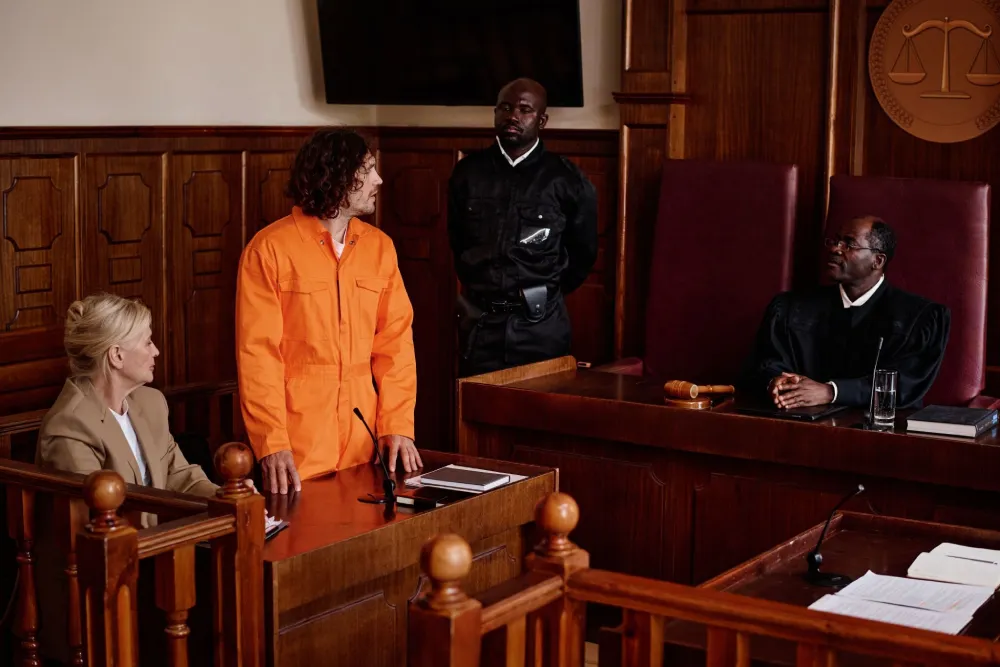
I want to start by telling you something that doesn’t get said enough.
Being charged with a crime does not make you a bad person. It makes you a person who is now navigating one of the most complicated, intimidating systems in American life — a system that has its own language, its own rhythms, its own unwritten rules — often without anyone in your corner who knows how it actually works.
Every week in my office I meet people who walk in pale with anxiety about their first court date. They’ve been searching online, asking friends, running through worst-case scenarios at three in the morning. And almost universally, the thing that helps most in that first meeting isn’t a complicated legal strategy. It’s someone sitting down with them and saying: here is what is going to happen, step by step, in plain English. Here is what you wear. Here is where you sit. Here is what the judge is going to say. Here is what you should — and absolutely should not — say back.
That’s what this guide is. A real, practical, honest walkthrough of what your first criminal court appearance looks like in Greensboro or High Point, North Carolina — written by someone who has been standing in those courtrooms for over a decade.
Whether you’re facing a misdemeanor charge in Guilford County District Court or something more serious in Superior Court, this guide will help you understand what’s coming. And by the end of it, I hope you’ll also understand why the single most important thing you can do before you walk through those courthouse doors is make one phone call first.
⚡ Key Takeaways — Read These Before Anything Else
- Your first appearance is not your trial — it’s an early procedural step, and in most cases it’s about establishing the record and hearing what the State has against you.
- Guilford County courts handle tens of thousands of criminal cases a year — the system moves fast, and judges and prosecutors have seen every situation. You need someone who has too.
- What you wear and how you carry yourself matters to a judge — appearance signals respect for the court, and judges are human beings who form impressions.
- You have the right to remain silent — and your first court appearance is not the place for you to try to explain your side of the story to a judge.
- Having an attorney present at your first appearance changes what happens — from bond conditions to how the case is framed going forward.
- District Court handles misdemeanors; Superior Court handles felonies — and the two courts operate very differently. Knowing which one you’re in matters.
- Pleading guilty at your first appearance is almost always a mistake — even if you think the case against you is strong.
- Huggins Law Firm offers free consultations — talk to Attorney Micah Huggins before your first court date, not after.
How Many People Go Through Criminal Court in Greensboro and High Point Every Year — and Who Actually Shows Up Ready?
Before we get into the practical details, let’s set the stage with some numbers — because understanding the scale of the court system in Guilford County is part of understanding why preparation matters so much.
80,000+
Criminal cases filed annually in NC District Courts statewide — making it one of the highest-volume systems in the Southeast (NC AOC, 2023)
Top 3
Guilford County ranks among NC’s top 3 counties by total criminal case volume, driven by Greensboro and High Point’s combined population of 430,000+
~70%
Of criminal defendants in NC misdemeanor cases do not have private legal representation at their first court appearance (NC AOC data and legal aid estimates)
3x
More likely to have charges reduced or dismissed with legal representation vs. self-representation in NC misdemeanor cases (American Journal of Criminal Justice, 2021)
That 70% figure — roughly seven out of ten misdemeanor defendants showing up to their first appearance without private legal representation — is one of the most important and least-discussed facts about the criminal court system in North Carolina. It’s not a judgment on those people. Most of them didn’t know how much their first appearance mattered. Some of them thought they’d “see how it goes” before hiring an attorney. Some of them didn’t realize they could afford one. Some of them genuinely didn’t understand what was at stake.
The North Carolina Administrative Office of the Courts reports that Guilford County District Court — which serves both Greensboro and High Point — processes a volume of criminal, traffic, and civil matters that ranks it consistently among the busiest trial courts in the entire state. The Greensboro courthouse at 201 South Eugene Street and the High Point courthouse at 505 East Green Drive both operate full criminal dockets, often scheduling dozens to over a hundred matters in a single morning session.
A stat worth knowing about the Triad specifically: According to FBI Uniform Crime Report data and the NC Department of Public Safety, the most common misdemeanor charges processed through Guilford County District Court include simple assault, misdemeanor larceny, communicating threats, driving while impaired, possession of drug paraphernalia, and driving with license revoked. The most common felony charges in Guilford County Superior Court include felony drug charges, breaking and entering, robbery, and felony assault. Understanding which category your charge falls into tells you which court you’ll be in — and what kind of process to expect.
What’s the Difference Between Guilford County District Court and Superior Court — and Which One Will Your First Appearance Be In?
In North Carolina, criminal cases are divided between two court levels depending on the severity of the charge. This is the first thing you need to know before anything else about your court date.
District Court — Misdemeanors and Traffic Offenses
If you’ve been charged with a misdemeanor — anything from a Class 3 (least serious) to a Class A1 (most serious misdemeanor) — or a traffic offense, your first appearance will be in Guilford County District Court. District Court is presided over by a District Court judge, and there is no jury. The judge alone decides guilt or innocence if the case goes to trial. In practice, most misdemeanor cases in District Court are resolved through pleas, prayer for judgment continued (PJC), or dismissal — and your first appearance is the beginning of that process, not the end. The Greensboro and High Point District Courts operate on their own docket schedules, which an attorney who practices there regularly will know well.
Superior Court — Felonies
Felony charges are handled in Guilford County Superior Court, which sits in the same Greensboro courthouse complex. If you’ve been indicted by a grand jury, or if you’re at the stage where a probable cause hearing has established sufficient evidence for a felony case to proceed, your case will be — or will move to — Superior Court. Superior Court involves a different set of procedures, including the right to a jury trial, and the consequences of conviction are generally far more serious. First appearances in felony cases often involve arraignment — where you formally enter a plea — and bond review.
An important nuance for Guilford County specifically: High Point, despite being in Guilford County, has its own separate District Court division. High Point cases are handled at the High Point courthouse, not the Greensboro courthouse — even though they’re part of the same Guilford County court system. If you’re not sure which courthouse your case is in, check your court date paperwork carefully, or call the Guilford County Clerk of Court’s office. Showing up at the wrong courthouse is more common than you’d think — and it creates an entirely avoidable problem.
Most Common Charges at First Appearances in Guilford County Courts
| Charge | Court Level | Class | Potential Consequence |
| Simple Assault | District | Class 2 Misd. | Up to 60 days jail |
| Assault on a Female | District | Class A1 Misd. | Up to 150 days jail |
| Misdemeanor Larceny (under $1,000) | District | Class 1 Misd. | Up to 120 days jail |
| DWI / Impaired Driving | District | Traffic/Crim. | Fines, license revocation, possible jail |
| Communicating Threats | District | Class 1 Misd. | Up to 120 days jail |
| Possession of Marijuana (≤0.5 oz) | District | Class 3 Misd. | Up to 20 days jail |
| Breaking and Entering | Superior | Class H Felony | 4–25 months prison |
| Felony Larceny (over $1,000) | Superior | Class H Felony | 4–25 months prison |
| Possession with Intent (drugs) | Superior | Class H/I Felony | 4–25 months prison |
| Robbery with Dangerous Weapon | Superior | Class D Felony | 38–160 months prison |
Who Are All These People in the Courtroom — and What Is Each of Them Actually Doing?
One of the most disorienting parts of a first court appearance is not knowing who anyone is or what they’re doing. Let’s fix that.
⚖️ The Judge
The person in the robe. In District Court, the judge runs the entire proceeding alone — no jury. They control the pace of the docket, make rulings on legal questions, and decide outcomes. Address them as “Your Honor.” Always stand when they enter or when you’re speaking to them directly. They have seen hundreds of people in your exact situation.
⚔️ The Prosecutor (ADA)
The Assistant District Attorney represents the State of North Carolina — not the victim, not the police, not any individual. Their job is to prosecute the case. In Guilford County, the DA’s office has specialized prosecutors for domestic violence, DWI, and other categories. They are experienced, prepared, and actively working your case before you arrive.
🛡️ Your Defense Attorney
The person in your corner. Their entire job is to protect your rights, challenge the State’s case, and advocate for the best possible outcome for you — at every stage. At your first appearance, your attorney can speak for you, negotiate with the prosecutor, raise legal issues, and prevent you from accidentally harming your own case. Their presence changes everything about how the proceeding goes.
📋 The Clerk of Court
Manages the administrative aspects of the court session — calling cases, maintaining records, swearing in witnesses, managing exhibits. If you have a question about your case file or need to find out when your case will be called, the clerk is the person to approach — quietly and respectfully.
🏛️ The Bailiff / Deputy
Maintains order in the courtroom. In Guilford County courts, these are typically Guilford County Sheriff’s deputies. They manage who enters the courtroom, ensure security, and will tell you where to sit if you’re uncertain. Follow their instructions without question — they are not people to argue with.
👥 Other Defendants
You will not be alone in the courtroom. In District Court especially, multiple cases are scheduled in the same session. You’ll wait while other cases are called before yours. This is normal. Use that time to observe how the court operates — it will calm your nerves and orient you before your name is called.
What Should You Wear to Your First Criminal Court Appearance in Greensboro or High Point?
I cannot overstate how much this matters. Judges are human. They form impressions. And the impression you make when you walk into Guilford County District Court or Superior Court in the first thirty seconds is one that colors every single thing that follows in that proceeding.
You are not going to court to make a fashion statement. You are going to court to demonstrate to a judge — through every available signal — that you take this seriously, that you respect the process, and that you are the kind of person who deserves a fair and reasonable outcome. Your clothes are part of that communication.
✔ Appropriate Court Attire
- Business casual or business professional — slacks, button-down shirt, blouse, dress
- Subdued, conservative colors — navy, gray, black, white, muted tones
- Clean, pressed clothing without wrinkles or stains
- Closed-toe shoes that are clean and in good condition
- Minimal jewelry — keep it simple and understated
- Hair groomed and neat — not disheveled or extreme
- Cover visible tattoos where reasonably possible
✘ What NOT to Wear
- Shorts, tank tops, flip-flops, or beachwear of any kind
- Clothing with offensive graphics, logos, or language
- Sports jerseys or athletic wear
- Hats or hoods worn inside the courthouse
- Sunglasses worn inside — take them off before entering
- Extremely bright or attention-drawing colors
- Clothing that is torn, dirty, or visibly unkempt
A note for clients who are genuinely worried about affording proper court clothing: This is something we take seriously at Huggins Law Firm. Several Greensboro and High Point area organizations, including Goodwill of Northwest NC and local community assistance programs, provide professional clothing at low or no cost to people preparing for court appearances. An attorney can point you toward these resources. Showing up to court dressed appropriately is something everyone can achieve regardless of budget — and it matters.
What Should You Bring to Your First Criminal Court Appearance in Guilford County?
📋 Bring This to Court
✓
Your court date paperwork — the summons, citation, or release paperwork that has your case number, courthouse location, and date/time. Do not lose this.
✓
A valid photo ID — driver’s license, state ID, or passport. You will be asked to identify yourself.
✓
Contact information for your attorney — and if you’ve hired Huggins Law Firm, we will already know your court date and be there with you.
✓
Any relevant paperwork related to your case — documentation of completion of any conditions, proof of enrollment in programs, character reference letters if your attorney has requested them.
✓
Cash or a card for parking — parking near the Greensboro courthouse on South Eugene Street and near the High Point courthouse can be limited. Budget time and money for this.
✓
Patience — court runs on its own schedule. Cases are called in a particular order, and you may wait longer than you expect. Plan for a half-day minimum.
⚠️ What NOT to bring to the Guilford County courthouse: No weapons of any kind — including pocketknives or multitools. No food or drinks (water in a sealed bottle is typically fine). Avoid bringing large bags or backpacks if possible — everything goes through security screening. Leave items that could create complications at home. And critically — do not bring anyone who might create a scene or cause a disturbance. Support is welcome; drama is not.
What Actually Happens at a First Criminal Court Appearance in Greensboro or High Point — Step by Step?
Here is the actual sequence of events on your court date, from the moment you leave home to the moment you walk back out. No surprises.
1Arrive Early — at Least 30 Minutes Before Your Scheduled Time
The Greensboro courthouse at 201 South Eugene Street has a security checkpoint at the entrance — metal detectors, bag screening, the full setup. During busy morning sessions, lines can be significant. Arriving 30 minutes early gives you time to clear security, find the right courtroom, locate the clerk to confirm your case is on the docket, and collect yourself before your name is called. Being late to a court date in Guilford County is not a minor issue — it can result in a failure to appear and a bench warrant issued before you even get through the door.
2Find Your Courtroom and Check in With the Clerk
Your court paperwork will have a courtroom number or district division listed. If it’s unclear, ask at the clerk’s window — staff there can tell you where your case is being heard. Let the clerk know you are present for your case. In Guilford County District Court, the clerk typically maintains a list of who has checked in, and judges note who is present when the session begins. Checking in signals you’re there and engaged — which is a meaningful first impression before you ever stand before the judge.
3Sit Quietly and Observe While Other Cases Are Called
In most District Court morning sessions in Greensboro and High Point, dozens of cases are on the docket. Yours may not be called first — or even close to first. Use this time well. Watch how other cases are handled. Observe how defendants address the judge and how attorneys speak on their clients’ behalf. You’ll see the rhythm of the court, get a sense of the judge’s demeanor, and feel less blindsided when your name is finally called. Do not use your phone. Do not talk to anyone except your attorney. Courtroom behavior is observed.
4Your Case Is Called — Approach the Bar or Stand at the Defendant’s Table
When your name is called, stand immediately and approach the front of the courtroom as instructed. If you have an attorney, they will be beside you or will have already positioned themselves at the defense table. You will stand at the bar or at the defendant’s table facing the judge. Stand straight. Keep your hands at your sides or folded in front of you. Make eye contact with the judge when they address you. Do not look at the floor, do not look at the prosecutor, and do not talk to anyone else while the judge is speaking.
5The Judge Will Confirm Your Identity and Address the Charge
The judge will typically confirm your name, address the charge against you, and advise you of your rights. At a first appearance, this often includes: your right to an attorney, your right to remain silent, your right to a trial, and a statement of the charge and the potential maximum penalty. This is not the moment to launch into an explanation. It is the moment to listen carefully. Your attorney will speak for you in response to any questions the court has.
6Bond or Release Conditions May Be Reviewed
If you were released on bond after arrest, the judge may review and confirm those conditions at the first appearance. If you were not previously released — for instance, if this is the first appearance following an arraignment — bond may be set at this stage. Your attorney can argue for reasonable bond conditions, present evidence of your ties to the community, your employment, your family situation, and any other factors that support release on appropriate terms. This advocacy at bond review is one of the most immediately practical ways legal representation helps you.
7A Continuance or Next Court Date Is Almost Always Set
In the vast majority of first appearances, the case is not resolved that day. Discovery — the process of the prosecutor sharing evidence with the defense — needs to happen. Your attorney needs time to review everything, investigate, and assess the case. A continuance date will be set. Your attorney will note it, you will note it, and you are expected to be present on that date as well. This is not a negative development. It is the normal process — and more time almost always benefits the defense, not the prosecution.
What Will the Judge Actually Say to You at a First Appearance in NC — Word for Word?
People are often less anxious about what’s going to happen when they know exactly what’s coming. Here’s a realistic account of what a judge in Guilford County District Court is likely to say at a first appearance on a misdemeanor charge:
Docket Called
“State of North Carolina v. [Your Name] — please approach.”
You and your attorney walk to the front. The judge looks at the file.
Identity Confirmed
“Are you [Your Name]? And your date of birth?”
You confirm your identity. Simple yes/no — no elaboration needed.
Charge Read
“You are charged with [charge], a Class [X] misdemeanor. Do you understand the charge?”
Answer: “Yes, Your Honor.” Nothing more.
Rights Advised
“You have the right to an attorney. If you cannot afford one, one will be appointed. You have the right to a trial. You have the right to remain silent. Do you understand these rights?”
Answer: “Yes, Your Honor.” Your attorney notes they are representing you.
Plea / Status
“How does the defendant wish to proceed?”
Your attorney will answer. In most first appearances, the answer is “not guilty” or “we’re requesting a continuance for discovery, Your Honor.” You say nothing at this point.
Next Date Set
“I’m continuing this to [date]. [Your Name], you are ordered to appear on [date] at [time]. Do you understand?”
Answer: “Yes, Your Honor.” Write the date down immediately. Your attorney will confirm it with you.
That’s often how a first misdemeanor appearance in Guilford County District Court goes. Less dramatic than television suggests. More important than it might appear. Because every exchange in that room, every piece of the record created, every impression formed — it all feeds into what happens next.
🚨 The most common mistake people make at a first court appearance: They try to explain themselves to the judge. They want the judge to know their side of the story. They say something like “but Judge, what really happened was…” And in doing so, they create a record — a statement that the prosecutor now has access to, that can be used in ways they didn’t anticipate. Your first court appearance is not the place to tell your story. There will be a time and a place for that — and your attorney will know exactly when and how to tell it effectively. That moment is not day one.
What’s the Real Difference Between Having Attorney Micah Huggins at Your First Appearance vs. Going Alone?
✔ With Huggins Law Firm
- Attorney has reviewed your case and knows what the prosecution has before you walk in
- Bond conditions are argued strategically — not accepted as-is
- You know exactly what to say and what not to say before you get there
- Discovery is formally requested from the prosecutor before you leave
- Attorney speaks for you — keeping your words out of the official record
- Judge sees a prepared, represented defendant — not someone navigating alone
- Early negotiation with the DA can begin even at the first appearance
- Continuance is requested with purpose — building time to build your defense
- You leave knowing the next step and what’s being prepared on your behalf
✘ Without an Attorney
- You don’t know what the prosecution has — or how strong it is
- Bond conditions are accepted without challenge or context
- You may say something that becomes part of the official record against you
- Discovery process is delayed or improperly initiated
- Judge forms an impression of someone who isn’t fully prepared
- No negotiation with the DA — you’re not in a position to do it
- You may be pressured toward a quick plea — without knowing your options
- You leave the courthouse confused about what comes next
- Prosecutors know when defendants are unrepresented — and they adjust accordingly
Your first court date in Greensboro or High Point is closer than you think. Don’t walk in without knowing what you’re walking into.
Talk to Attorney Micah Huggins — Free, Confidential Consultation
Why Do People Across Greensboro, High Point, and the Triad Trust Huggins Law Firm With Their First Day in Court?
Something I’ve noticed over more than a decade of criminal defense practice in Guilford County is this: the clients who do best are almost never the ones who had the weakest cases or the most sympathetic circumstances. They’re the ones who came in early, prepared, with someone in their corner who knew the terrain.
Walking into Guilford County District Court for the first time without preparation is like walking into a job interview in a field you’ve never worked in, for a position you’ve never applied for, in a language you don’t fully speak — while the other side has been doing this every single day for years. The prosecutors in Guilford County are experienced professionals. The judges have seen every situation a human being can create. The system has been doing this without you for a long time, and it will continue to do it efficiently with or without your understanding of how it works.
What you need is someone who understands it — and who is there specifically to make sure that system works for you, not just through you.
✔ What Huggins Law Firm brings to your first court appearance: A thorough review of your charge, the evidence, and your background before day one. A clear conversation with you about exactly what to expect — what the judge will say, what you should say, how to carry yourself. Active advocacy at bond review if needed. Formal initiation of the discovery process. Early, strategic communication with the Guilford County DA’s office. And the one thing that I think matters more than any of it — someone standing beside you who is completely in your corner, who has been in that room hundreds of times, and who is not intimidated by any of it.
We represent clients in criminal defense, family law, personal injury, and estate planning. We serve Greensboro, High Point, Winston-Salem, Burlington, Graham, Kernersville, and Asheboro. And we’ve been doing it for over a decade with the same commitment that founded this firm: every client deserves clarity, compassion, and a champion in their corner.
If your first court date is coming up — or if you’re not even sure when it is — call us. The consultation is free. The peace of mind is real. And what you learn in that first conversation could change everything about how your case goes.
👉 Schedule your free consultation at micahhuggins.com — before your court date, not after.
You Don’t Have to Walk Into That Courtroom Alone
Your first court appearance in Greensboro or High Point is one of the most important days in your case. Let Attorney Micah Huggins prepare you, stand beside you, and fight for you from day one. The consultation is free. The difference is real.
Call Huggins Law Firm — Free Case Consultation
The 10 Questions People Going to Court for the First Time in NC Ask Most
1. Will I go to jail at my first criminal court appearance in North Carolina?
In most misdemeanor first appearances in Guilford County District Court — no. First appearances are typically procedural, and if you’ve already been released on bond or on a written promise to appear, you will generally remain free during the proceeding. However, if you violate any condition of your release, if a new warrant surfaces, or if you’re in custody awaiting a bond hearing, the situation is different. The risk of being taken into custody at or after a first appearance is one of the reasons having an attorney present is so important — they can respond to unexpected developments in real time. Call Huggins Law Firm before your date to understand your specific situation.
2. Should I plead guilty at my first court appearance to “just get it over with” in NC?
Almost never — and this is one of the most important pieces of advice I can give. Pleading guilty at your first appearance means you’ve given up any opportunity to challenge the evidence, explore alternatives like deferred prosecution or conditional discharge, negotiate for reduced charges, or present mitigating circumstances. You don’t yet have the discovery materials — the evidence the prosecution has — so you’re making a permanent decision without full information. Even in cases where the evidence against you is strong, an attorney can often negotiate a significantly better outcome than an uninformed early guilty plea. The case almost never looks the same after discovery as it did at first appearance.
3. What happens if I miss my first criminal court date in Greensboro or High Point?
A bench warrant is issued — often in the same court session, sometimes within minutes of the scheduled time passing. That warrant will remain active indefinitely, can affect your driver’s license, will show on background checks, and can result in arrest at any traffic stop or routine law enforcement encounter. If you know you’re going to miss a court date — for any reason — contact an attorney immediately so the situation can be addressed proactively before the warrant is issued. If a warrant has already been issued, Huggins Law Firm handles bench warrant resolution across Guilford County and the Triad.
4. Can I bring family or friends to my court appearance in Guilford County?
Yes. Courtrooms in North Carolina are generally open to the public, and having supportive family or friends present is completely appropriate. They should dress respectfully, maintain silence during the proceedings, follow all courtroom rules, and not attempt to speak or intervene in any way. Support in the gallery can be meaningful — judges notice when a defendant has people in their corner — but it should be quiet, calm, and dignified support. Anyone who might create a disruption should stay home. The courtroom is not a place for emotional outbursts, even well-intentioned ones.
5. How long will my first court appearance take in Greensboro or High Point?
The individual proceeding on your case may be as brief as 10–20 minutes for a routine first appearance. But you should plan for a half day minimum — sometimes a full day — because you will be in a court session with many other cases, and yours may not be called early. Guilford County District Court morning sessions in Greensboro can have 40 to 100+ matters on the docket. The wait is normal, it doesn’t mean anything is wrong with your case, and it’s part of how the system operates. Come prepared to wait, and use the time to observe.
6. What is “discovery” and when does it happen in a North Carolina criminal case?
Discovery is the process by which your attorney obtains the evidence the prosecution intends to use against you — police reports, witness statements, video footage, lab results, and anything else relevant to the case. In North Carolina, formal discovery is typically requested after the first appearance, and the prosecutor is required under NC law to share certain categories of evidence. This is one of the reasons first appearances are almost always continued — discovery takes time, and your attorney needs to see everything before advising you on how to proceed. Without discovery, you’re fighting blind. With it, the whole picture of the case becomes clear.
7. What is a “Prayer for Judgment Continued” (PJC) and can it help at my first appearance in NC?
A PJC is a uniquely North Carolina legal tool where a judge accepts a guilty plea but defers entering a formal judgment — which can prevent certain consequences of a conviction in limited circumstances. It is not something that is typically resolved at a first appearance, and it requires careful legal analysis to determine whether it’s appropriate for your situation. Some charges are not eligible; others carry specific limitations on how many times a PJC can be used. This is exactly the kind of strategic option your attorney will evaluate during the period between your first appearance and the resolution of your case — another reason why early legal engagement matters.
8. I can’t afford to hire a private attorney. What are my options for legal representation in Guilford County?
If you cannot afford private legal representation, you have the right to a court-appointed public defender if you face the possibility of incarceration. The Guilford County Public Defender’s office provides representation for qualifying defendants. That said, public defenders handle extraordinarily high caseloads — often hundreds of cases at a time — which limits the individualized attention any one case can receive. Private legal representation, when it is financially possible, typically allows for more thorough case review, more client contact, and more strategic flexibility. At Huggins Law Firm, the initial consultation is free — and we’re committed to discussing what representation might look like for your specific situation. Call us before making that determination.
9. Will my employer find out about my court appearance in North Carolina?
Court records in North Carolina are generally public — meaning an employer who looks for them can find them. However, most employers don’t actively monitor court calendars for individual employees. The more practical risk is a criminal background check — if you are convicted, that conviction will appear. An arrest alone may also appear in some background check formats. This is one of the most compelling reasons to fight aggressively for the best possible outcome from the very beginning of your case, rather than accepting a quick plea. A charge that’s dismissed or handled through a deferred prosecution leaves a very different record than a conviction. An attorney fights for those outcomes. Huggins Law Firm can discuss your specific concerns.
10. How do I find out the exact location and courtroom for my first appearance in Guilford County?
Your court summons, citation, or release paperwork should list the courthouse address and, in many cases, the courtroom or division. For Greensboro cases, the Guilford County courthouse is at 201 South Eugene Street. For High Point cases, the courthouse is at 505 East Green Drive. You can also check the NC Courts Case Information portal or call the Guilford County Clerk of Court’s office to confirm. If you’ve retained Huggins Law Firm, we will confirm all of this for you and make sure you know exactly where to be and when — so the logistics are never an excuse for a missed date.