
Key Takeaways
- Actual vs. Constructive: “Actual possession” means the item was in your pocket or hands. “Constructive possession” means it was not on you, but the police believe you had the power and intent to control it.
- Just Being There Is Not Enough: Simply being in a car or room where drugs or firearms are found does not automatically make you guilty under North Carolina law.
- The Burden of Proof: The state must prove beyond a reasonable doubt that you knew the illegal items were there and intended to control them.
- Local Court Backlogs: North Carolina courts have massive backlogs (over 900,000 pending cases). An experienced lawyer can use time and strategy to your advantage.
- Huggins Law Firm P.C. Can Help: We have over a decade of award-winning experience. We believe every client deserves clarity, compassion, and a champion in their corner.
Hi there. My name is Attorney Micah Huggins. I am the founder of Huggins Law Firm, P.C. Let’s talk about a very scary situation that happens to good people every single day.
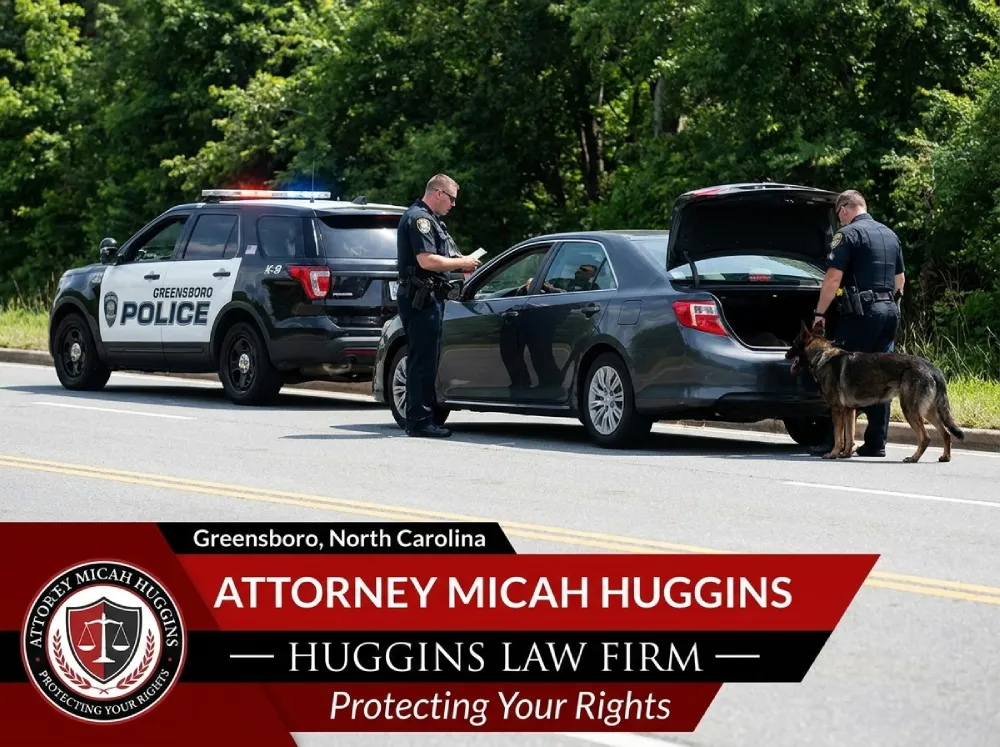
Imagine you are driving down the road in Greensboro. A friend is riding in your passenger seat. The police pull you over for a broken taillight. One thing leads to another, and the police search your car. They find a bag of illegal drugs or an unregistered firearm hidden under the passenger seat.
You panic. You tell the police, “Those aren’t mine!” But suddenly, you are the one in handcuffs. You are being charged with a serious crime.
How can this happen? How can you be charged for drugs or guns that you did not even know were there? It all comes down to a tricky legal rule called “constructive possession.”
At Huggins Law Firm, we see this all the time. We have been in business for over a decade. We represent the accused in Greensboro, Graham, Burlington, Asheboro, High Point, Kernersville, and Winston-Salem. Our firm is built on a simple promise: Justice with Integrity. Representation with Heart. Great representation goes beyond just knowing the law. It is about standing up for people when the stakes are high, when the odds are heavy, and when the system feels totally overwhelming. Today, I want to explain exactly what constructive possession is. I will also share how we fight these unfair charges in North Carolina.
What is Constructive Possession vs. Actual Possession in NC?
If you are Googling, “charged for drugs that weren’t mine in NC,” you need to understand two big legal terms.
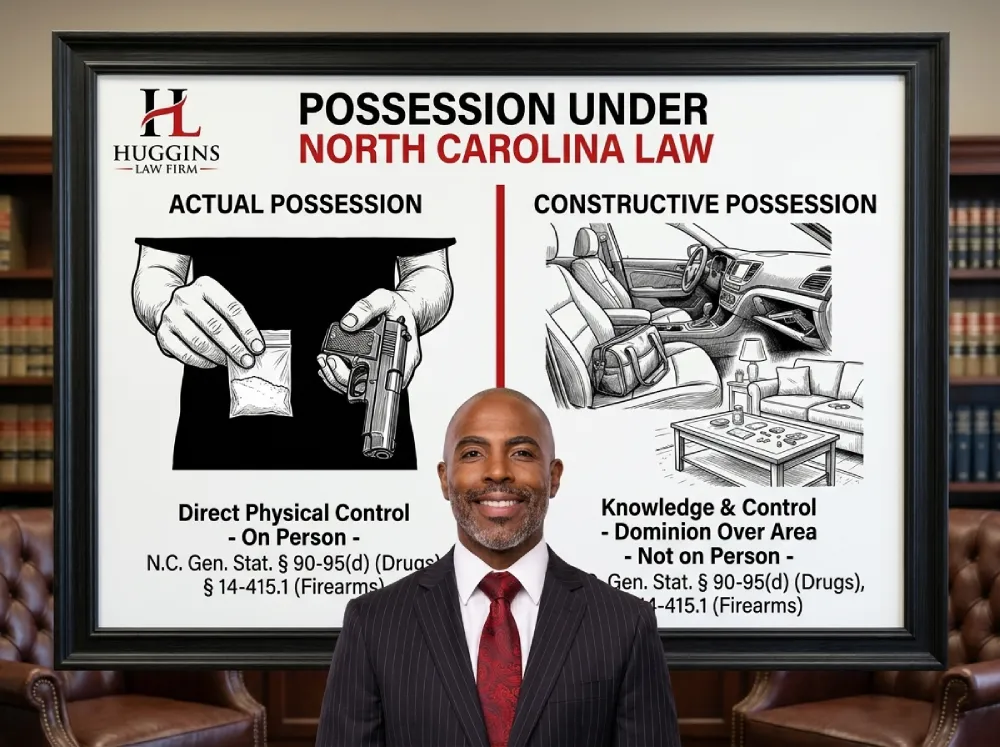
1. Actual Possession: This is simple. This means the police found the illegal item right on your body. The drugs were in your pocket. The gun was in your hand. The item was in a purse you were wearing. It is very hard to argue that the item was not yours if it was actually physically on you.
2. Constructive Possession: This is much more complicated. This means the item was not on your body. Instead, it was found nearby. It could be found in the center console of a car, in the trunk, in a shared bedroom, or under a couch cushion.
For the police to charge you with constructive possession, they have to prove two things:
- You knew the drug or gun was there.
- You had the power and intent to control the drug or gun.
This rule is why so many people get swept up in drug arrests. The police often arrest everyone in the car or everyone in the house and let the courts sort it out later. But getting arrested does not mean you are guilty. At our criminal defense law firm, we dig into the facts. We know that just being near an illegal item is not a crime.
How Common Are Drug and Gun Charges in Greensboro and High Point?
You might feel like you are the only one going through this. You are not alone. Let’s look at some real numbers. I like to look at statistics that very few people are talking about. It helps us understand the local court system.
According to the North Carolina Department of Health and Human Services, from the year 2000 to 2024, more than 44,500 people in our state lost their lives to drug overdoses. Because of this tragic health crisis, police are cracking down harder than ever.
In High Point, the police department has used something called the “Drug Market Intervention Strategy” for many years. According to High Point city data, this focus helped drop violent crime by 15% recently. But it also means the police are highly active. They are pulling people over. They are searching cars. They are doing major drug busts.
In fact, just recently, state agents did huge crackdowns on illegal alcohol and drug sales in Guilford County. The North Carolina Department of Public Safety reports major sweeps that catch many people in the crossfire.
When the police cast a wide net, innocent bystanders get caught. If you are sitting at a table where someone else is secretly hiding drugs, you might get charged. This is why you need a lawyer who knows the local area and the local judges.
If I Am in a Car With Drugs, Am I Automatically Guilty?
The short answer is no. Absolutely not.
North Carolina courts have ruled time and time again that “mere proximity” is not enough. “Proximity” is just a fancy word for being close to something.
Let’s say you are getting a ride home from a coworker in Asheboro. The police pull the car over. They find a gun in the glovebox. You had no idea it was there. The police might arrest you both. But the prosecutor has to prove you knew about the gun and intended to control it.
How does the state try to prove this? They look for “incriminating circumstances.” Here are some things the police look for to trap you:
- Ownership of the car: If you own the car, the courts often guess that you know what is inside it.
- Your behavior: Did you look super nervous when the police pulled you over? Did you sweat or shake?
- Where the items were: Were the drugs sitting in plain sight on the dashboard, or were they buried deep inside a locked box?
- Your belongings: Were your personal items (like your wallet or mail) sitting right next to the drugs?
If you are facing this, you need a lawyer who fights with strategy. We don’t just show up in court. We challenge the police reports. We ask the tough questions. How could our client see drugs hidden in a dark car at midnight? They couldn’t.
What Are the Hidden Court Statistics in Guilford County?
Here is a statistic that will blow your mind. Very few people know about the massive backlog in our North Carolina court system.
During the COVID-19 pandemic, the courts shut down. This created a giant traffic jam of cases. According to the North Carolina Judicial Branch, the state had a peak backlog of 1.2 million pending cases! Recently, they worked hard to reduce that number by 25%. Today, there are still roughly 900,000 pending cases in the system.
Why does this matter to you? Because the courts in Guilford County and Forsyth County are extremely busy. Prosecutors have hundreds of cases on their desks. They are overworked.
If you walk into court alone, they might try to push you into a fast guilty plea just to clear their desk. But if you have an experienced attorney, we can use this to your advantage. We take the time to deeply review the evidence. We file motions. When prosecutors see that we are fully prepared to fight a weak “constructive possession” case, they are much more likely to negotiate, drop the charges, or offer a better deal. We bring preparation, precision, and purpose to every single case.
Can the Police Prove Constructive Possession in My House?
Yes, they can try. But it is just as hard to prove in a house as it is in a car.
Imagine you rent an apartment in Burlington with two roommates. The police show up with a search warrant. They find illegal drugs in the common living room or in the kitchen. They decide to charge all three of you with possession.
To win this case, the state has to connect the drugs directly to you. Did you buy them? Did you use them? Were they mixed in with your groceries?
We look at the facts. We counsel with empathy. We understand how terrified you are of losing your job, your home, or your freedom over a roommate’s bad choices. We will make the state prove every single detail. If they can’t prove the drugs belonged to you, the case falls apart.
Why Do You Need an Experienced NC Lawyer for a Possession Charge?
Being convicted of a drug or gun crime in North Carolina can ruin your life. It can put you in prison. It can cost you thousands of dollars in fines. It will give you a permanent criminal record. It can stop you from getting a good job or renting an apartment.
We work to restore what has been lost — your dignity, your stability, and your peace of mind. Every client deserves clarity. We explain things in plain English, not confusing legal talk. Every client deserves compassion. We do not judge you. And every client deserves a champion in their corner.
At Huggins Law Firm, P.C., we do more than just criminal cases. We also help families protect their futures. We represent clients in Family Law Cases, Estate Planning, and Personal Injury. If you were hurt in a crash, we handle personal injury cases with the same fierce dedication. If you need a will or are going through a tough divorce, our family law and estate planning team is here for you. We are highly rated. We have won multiple awards. We know the local system inside and out.
How Do We Fight Your Constructive Possession Case?
When you hire Attorney Micah Huggins, we get right to work. Here is our playbook for fighting false possession charges:
1. We check the traffic stop. Did the police have a valid reason to pull you over in the first place? If they broke the rules, we can ask the judge to throw out the evidence.
2. We check the search. Did the police have a warrant? Did they have probable cause to search your car or house? The Fourth Amendment protects you from illegal searches.
3. We attack the “knowledge” link. We force the prosecutor to prove you actually knew the item was there. If it was hidden, we argue you had no idea.
4. We attack the “control” link. Even if you knew your friend had drugs in their pocket, that does not mean you had the power to control those drugs.
5. We look at the lab results. For drug cases, the NC State Bureau of Investigation (SBI) lab has to test the substance. Sometimes, they make mistakes. Sometimes, the testing takes months or years. We hold them accountable.
We fight for you from the first day until the final gavel drops.
10 Common Questions Asked to Lawyers in NC About Constructive Possession
To help you understand this topic even better, I have put together the ten most common questions people ask us when they call our office.
1. What is the penalty for drug possession in North Carolina?
It depends on the type and amount of the drug. Simple possession of a small amount of marijuana is a misdemeanor. Possession of harder drugs like cocaine, heroin, or methamphetamine is usually a felony. Felonies carry heavy fines and potential prison time.
2. Can I go to jail for a gun found in a friend’s car?
Yes, if the state can prove constructive possession. If the gun is stolen or if you are a convicted felon who is not allowed to be around guns, the charges are very severe.
3. If my friend admits the drugs are theirs, will my charges be dropped?
Not always. Even if your friend claims ownership, the police might still believe you were sharing the drugs or helping to transport them. It helps your case a lot, but you still need a lawyer to convince the prosecutor to formally drop your charges.
4. What if the police did not read me my Miranda rights?
If you were arrested and questioned without being read your rights, anything you said might be thrown out of court. However, it does not automatically make the entire case go away. The physical evidence (the drugs or guns) might still be used against you.
5. Can constructive possession apply to stolen property?
Yes. The rule of constructive possession applies to anything illegal. This includes drugs, guns, stolen goods, or illegal pornography. If you have the power and intent to control the illegal item, you can be charged.
6. Will I lose my driver’s license for a drug charge?
In some cases, yes. North Carolina used to automatically suspend licenses for drug convictions, but the laws have changed a bit. However, certain convictions can still impact your driving privileges. We fight hard to keep you driving.
7. Does the prosecutor have to show my fingerprints on the drugs or gun?
No. Fingerprints are a type of actual physical evidence. The whole point of constructive possession is that the state does not have to prove you physically touched the item. They just have to prove you knew it was there and had control over the area.
8. What is “joint constructive possession”?
This means the police believe more than one person had control over the illegal item. For example, a husband and wife might be charged with joint constructive possession of drugs found on their shared kitchen table.
9. How much does a criminal defense lawyer cost in Greensboro, NC?
The cost depends on how complex your case is. A misdemeanor is usually less expensive than a felony trial. At Huggins Law Firm, we are upfront and honest about our fees. We believe in providing extreme value and peace of mind.
10. Can a possession charge be wiped off my record?
If your case is dismissed or you are found not guilty, we can file for an expungement to wipe the charge off your record completely. Even if you are convicted of a non-violent misdemeanor, you might be eligible for expungement after a certain number of years.
Being accused of a crime is terrifying. Feeling like the police twisted the truth is frustrating. But you do not have to face the legal system alone. We know the courts in Greensboro, Graham, Burlington, Asheboro, High Point, Kernersville, and Winston-Salem. We know how to build a strong defense.
Remember, an arrest is not a conviction. You have rights. You deserve a fair fight. If you or someone you love is dealing with a tough legal situation—whether it is a criminal charge, a family law issue, planning your estate, or a personal in
2. Can a DWI Be Reduced to Reckless Driving in North Carolina?
- Why it works: Your client currently has no blog posts specifically answering common DWI questions. This is one of the most frequently searched questions by people who have just been arrested for a DUI/DWI.
3. College Student Arrests in Greensboro: How a Charge Affects Your UNCG or NC A&T Enrollment
- Why it works: Greensboro has a massive student population. Neither competitor is heavily blogging about the intersection of criminal charges (like underage drinking, fake IDs, or campus drug possession) and university disciplinary hearings (Title IX / Student Conduct boards).
4. How is Bail Set in Guilford County & How to Get a Bond Reduction
- Why it works: Garrett & Walker touches on “Bond Motions.” Families of incarcerated individuals frantically search for how to get their loved ones out of the Greensboro or High Point jails. A localized guide explaining the Guilford County bond guidelines will drive high-converting traffic.
5. State vs. Federal Criminal Charges in North Carolina: What’s the Difference?
- Why it works: Your client handles Federal Crimes (listed in practice areas), but there is no blog content explaining why a crime goes federal (e.g., crossing state lines, crimes on federal property, federal drug conspiracy). This establishes high-level authority.
6. Can the Police Search My Car in NC Without a Warrant?
- Why it works: This captures top-of-funnel traffic. People who were recently pulled over on I-40 or local Greensboro roads often search for this if they feel their 4th Amendment rights were violated during a traffic stop.
7. Driving While License Revoked (DWLR) in NC: Penalties and How to Get Your License Back
- Why it works: Garrett & Walker dominates traffic ticket content. DWLR is a very common, frustrating charge that often requires a lawyer to untangle. Content detailing DMV hearings and license restoration is highly searchable.
8. North Carolina’s Habitual Felon Law Explained (The “Three Strikes” Rule)
- Why it works: Aberle & Connolly has a post on this, and for good reason. Defendants with a criminal record are terrified of habitual felon status, which drastically enhances sentencing. Explaining how this works in NC shows advanced legal expertise.
9. Self-Defense Laws in North Carolina: When is Force Justified?
- Why it works: Your client covers assault and homicide charges. Writing a post about “Stand Your Ground” laws, the duty to retreat, and self-defense in North Carolina is excellent for pulling in users researching assault and battery defenses.
10. What Happens to My Gun Rights After a Felony Conviction or DVPO in NC?
- Why it works: Gun rights are a massive concern for North Carolinians. Explaining the loss of Second Amendment rights following a felony conviction or a Domestic Violence Protective Order (50B), and whether those rights can ever be restored, is a highly engaging and heavily searched topic.